
Product safety remains a line between profitable distribution and costly recalls in the global electrical market. Inadequate overcurrent protection, substandard plug construction, insufficient insulation, and overheating continue to trigger compliance alerts for imported extension leads.
For importers, wholesalers, and OEM buyers, sourcing reliable power strips goes far beyond matching outlet counts, cable lengths, and basic wattage ratings. True product reliability depends on internal copper thickness, component grade, compliance certification, and rigorous factory testing.
Below is a practical guide from our engineering team on common power strip safety risks, key international standards (BS1363, CE, UL), and essential factory inspection checkpoints for B2B buyers.
Recent Power Strip and Extension Lead Safety Alerts
Recent regulatory actions demonstrate why power strip safety remains an important issue in international electrical product markets.
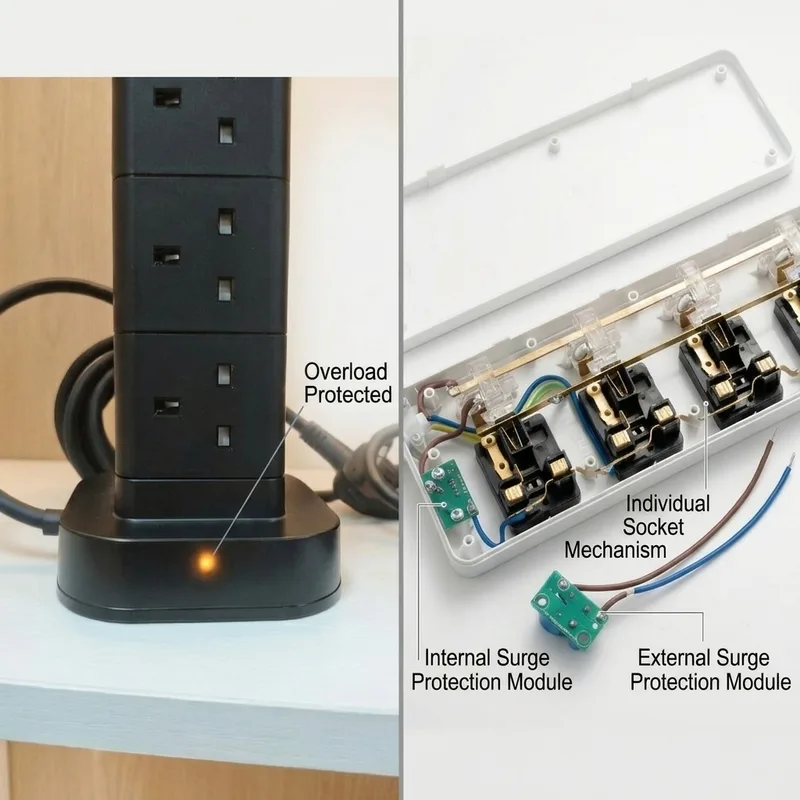
1. US CPSC Recall: Missing Overcurrent Protection
On March 26, 2026, the US Consumer Product Safety Commission (CPSC) announced a recall involving approximately 5,543 CCCEI-branded power strips.
According to the official CPSC recall notice, the products did not contain supplementary overcurrent protection, creating a fire risk if the power strips were overloaded. The retailer had received two reports of the products sparking and melting.
This case highlights the importance of selecting appropriate protective components and verifying their performance under the intended electrical conditions.
For importers and distributors, overcurrent protection should be evaluated as part of the complete product design rather than treated as an optional feature without considering the product’s intended application and applicable requirements.
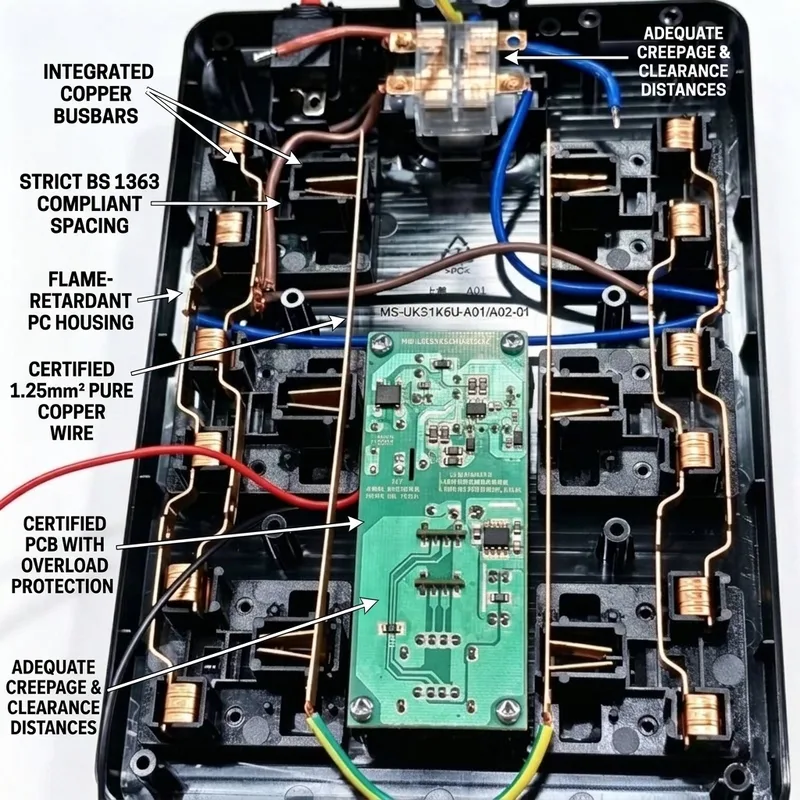
2. UK OPSS Report: Extension Lead Failed BS 1363 Requirements
In December 2025, the UK’s Office for Product Safety and Standards (OPSS) published a safety report concerning a multi-socket extension lead that presented a high risk of fire.
The official UK product safety report identified insufficient creepage and clearance distances. The live and neutral pins were also too short and positioned too close to the periphery of the plug, potentially resulting in poor contact, overheating, or other hazards.
The product failed to meet the relevant BS 1363 requirements, and the import was rejected at the border and destroyed.
More recently, an August 2026 OPSS report identified another extension lead with poorly secured internal wiring and inadequate strain relief. The 2026 product safety report highlights how weak internal connections can increase the risk of electric shock and fire.
These cases show that product safety depends on more than the external appearance of a plug or socket. Internal construction, electrical clearances, wiring connections, and mechanical protection must also be properly evaluated.
Common Electrical Safety Risks in Power Strips
Understanding common failure mechanisms helps buyers assess product quality before placing bulk orders.
1. Electrical Overload and Excessive Current
Electrical overload occurs when the connected appliances draw more current than the power strip, plug, or cable is designed to carry.
Excessive current can increase conductor temperature and place additional stress on terminals, internal wiring, and insulation materials. If the product lacks appropriate protective measures, prolonged overload conditions may increase the risk of overheating and fire.
Buyers should verify the rated voltage, maximum current, power capacity, conductor size, and applicable protective components.
For example, a UK extension lead rated at 13A should be selected and used according to its marked rating and applicable requirements. The total connected load must not exceed the product’s permitted capacity.
2. Poor Electrical Contact and Loose Connections
Electrical contact quality is another important factor in power strip safety.
Loose terminals, poor crimping, inadequate soldering, or unstable internal connections can increase contact resistance. Under load, higher resistance at a connection point may cause localized heating.
Manufacturers should pay attention to terminal structure, conductor preparation, connection methods, and assembly consistency.
Electrical continuity and connection stability should be checked during production and quality inspection.
3. Insufficient Insulation and Electrical Clearance
Insulation systems help prevent unintended contact between conductive components.
Insufficient creepage and clearance distances may increase the risk of electrical breakdown, tracking, or arcing, depending on the operating conditions and product construction.
The selection of insulation materials, internal structural design, and spacing between conductive parts should be evaluated against the applicable product standard.
4. Undersized or Inappropriate Power Cables
The cable is an essential part of the complete power strip assembly.
If the conductor cross-sectional area is unsuitable for the rated current, installation conditions, or intended application, the cable may experience excessive temperature rise.
Buyers should verify:
- Conductor material and cross-sectional area.
- Number of cores and cable construction.
- Rated voltage and current.
- Insulation and sheath material.
- Cable temperature rating and applicable product requirements.
Copper conductor specifications, cable structure, and insulation quality should be consistent with the product’s intended electrical rating.
5. Inadequate Housing and Insulation Materials
The housing protects internal electrical components and helps maintain the product’s mechanical structure.
Unsuitable plastics may deform under heat or fail to provide the required insulation and flame-retardant performance.
Material selection should consider the product’s operating environment, mechanical requirements, temperature conditions, and applicable flammability requirements. Where relevant, buyers should request supporting material test reports rather than relying only on general descriptions such as “fireproof plastic.”
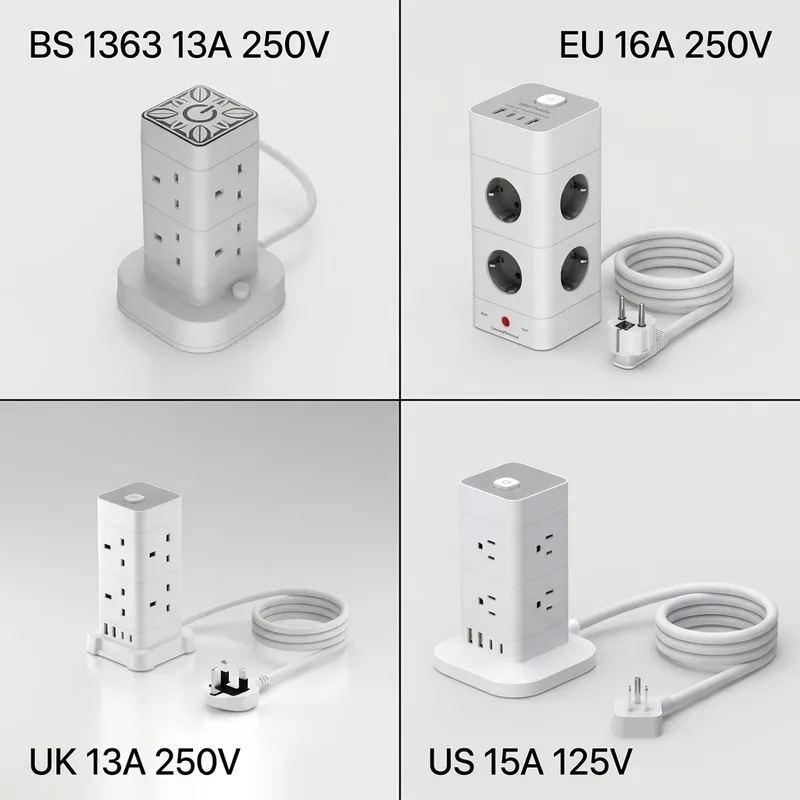
Power Strip Safety Standards in Different Markets
Power strips, extension leads, plugs, and socket outlets are subject to different technical requirements depending on the target market and product category.
Buyers should identify the applicable standard for the complete product rather than assuming that one standard covers every type of electrical extension product.
1. UK Market: BS 1363
For UK products using standard three-pin plugs, BS 1363 is an important product standard covering relevant plug and socket configurations.
For extension leads, buyers should verify the applicable requirements for the plug, fuse where required, socket outlets, cable, construction, and product marking.
A compliant plug alone does not automatically establish that the complete extension lead meets all applicable safety requirements.
2. US Market: Applicable ETL Requirements
Power strips and extension cords sold in the United States may fall under different product standards depending on their construction and intended use.
For example, UL 817 covers cord sets and power-supply cords, while relocatable power taps and other outlet devices may be subject to different requirements.
The CPSC extension cord business guidance explains important observable safety characteristics for extension cords, including minimum wire size, strain relief, polarity, and continuity.
Importers should confirm the correct standard and certification route for the specific product category with the relevant certification body or testing laboratory.
3. International Reference: IEC 60884-1
IEC 60884-1:2022 specifies general requirements for plugs and fixed or portable socket-outlets for household and similar purposes within its defined voltage and current scope.
The standard covers important aspects of plug and socket-outlet construction and performance.
Buyers can refer to the official IEC 60884-1 publication for its scope and technical information.
However, IEC 60884-1 should not be treated as a universal replacement for national product standards. Requirements for a finished power strip or extension lead must be checked against the applicable market regulations and product-specific standards.
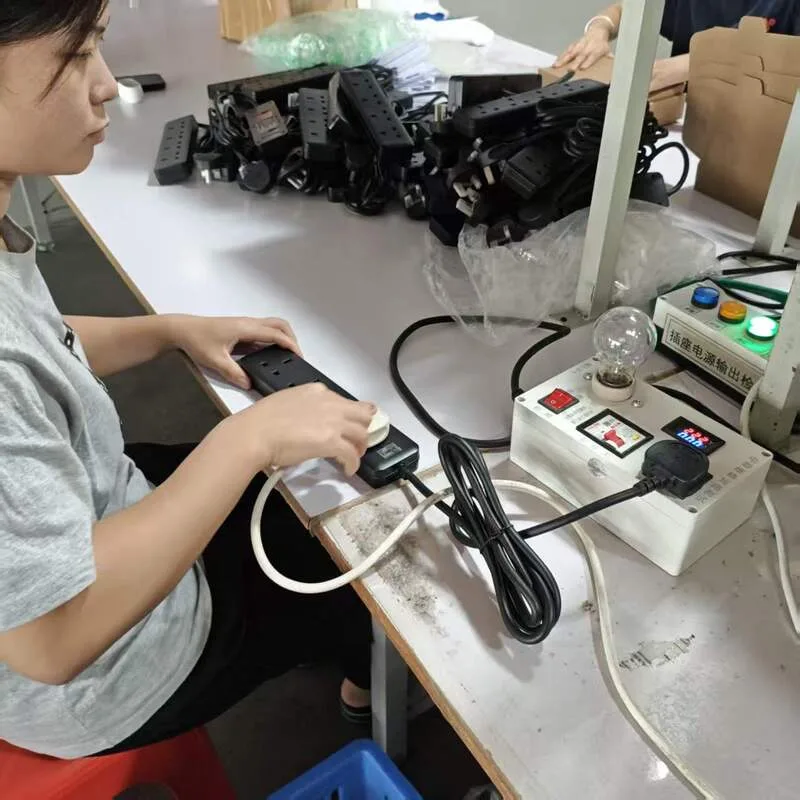
Key Quality Inspection Procedures for Power Strips
A structured quality control process helps manufacturers identify potential defects before products reach the market.
For B2B buyers, the following inspection areas are worth reviewing when evaluating a power strip manufacturer.
1 Incoming Material Inspection
Incoming materials should be checked against approved specifications.
Important inspection points include:
- Copper conductor material and wire size.
- Cable insulation and sheath materials.
- Plug pins, socket contacts, and terminal components.
- Housing material and supporting test documentation.
- Switches, fuses, and protective components where applicable.
Material consistency helps reduce variations between production batches.2 Electrical Performance Testing
Electrical testing should be selected according to the product design and applicable standards.
Depending on the product, inspection may include:
- Continuity and polarity checks.
- Insulation resistance testing.
- Dielectric strength testing.
- Contact and connection checks.
- Temperature-rise testing.
- Functional testing of switches and protective components.
The test methods, acceptance criteria, and test conditions should be defined according to the relevant product requirements.3 Mechanical and Structural Inspection
Mechanical inspection helps verify that the product can withstand normal handling and intended use.
Typical inspection points include:
- Plug pin dimensions and structural integrity.
- Socket contact retention and stability.
- Cable entry and strain relief.
- Housing assembly and fastening.
- Switch operation and mechanical fit.
- Product dimensions and external appearance.
These checks are particularly important for products with multiple outlets, individual switches, rotating structures, or wall-mounting features.
4.4 Final Inspection and Packaging
Before shipment, finished products should undergo visual inspection, specification verification, and applicable functional checks.
Packaging should also be reviewed to ensure that products are protected during storage and transportation.
Product labels, rated electrical information, warnings, model identification, and certification markings should be checked for consistency with the approved product documentation.
Key Quality Inspection Procedures for Power Strips
A reliable quality inspection process helps ensure product safety and consistent manufacturing quality.
1. Incoming Material Inspection
- Check copper conductors and cable specifications.
- Inspect plug pins, socket contacts, and terminals.
- Verify housing materials, switches, and protective components.
2. Electrical Performance Testing
- Continuity and polarity testing.
- Insulation resistance and dielectric strength testing.
- Temperature-rise and functional testing.
3. Mechanical and Structural Inspection
- Check plug pins and socket contacts.
- Inspect cable connections and strain relief.
- Verify housing assembly, switches, and overall dimensions.
4. Final Inspection and Packaging
- Check product appearance and basic functions.
- Verify labels, ratings, and certification markings.
- Inspect packaging before shipment.
What Should B2B Buyers Check Before Sourcing Power Strips?
When comparing suppliers, buyers should look beyond unit price and product appearance.
The following checklist can help importers and distributors evaluate potential manufacturers.
| Evaluation Area | What Buyers Should Verify |
|---|---|
| Product rating | Rated voltage, current, and maximum power |
| Cable specification | Conductor material, wire size, and cable type |
| Plug and socket | Market-specific design and applicable requirements |
| Protective components | Fuse, overload protection, or other features where applicable |
| Housing material | Insulation properties and supporting material documentation |
| Electrical testing | Relevant test procedures and inspection records |
| Certifications | Valid documents for the exact product model and target market |
| Manufacturing capability | In-house production, assembly, and quality control |
| Customization | Plug types, outlet configurations, cable length, and branding |
A reliable supplier should be able to explain the product’s construction, provide relevant technical documentation, and demonstrate how quality is controlled throughout manufacturing.
SEBLIP Power Strip Manufacturing and Quality Control
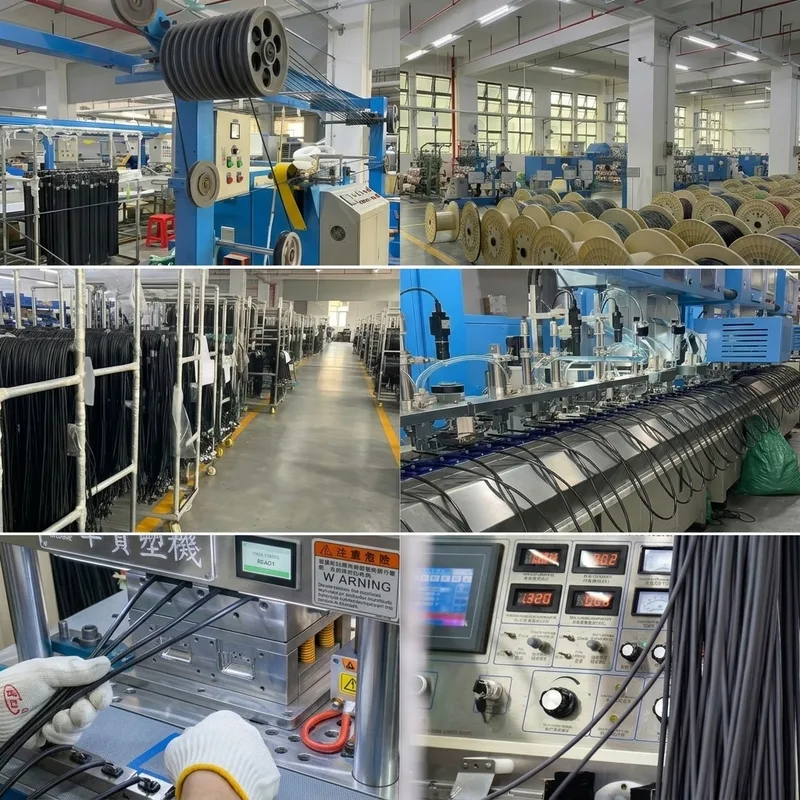
SEBLIP, manufactured by Dongguan Zheng Hao Electric Company Ltd., provides power cords, extension cords, power strips, adapters, and plug components for international B2B customers.
With over 20 years of factory experience and a 40,000 m² manufacturing facility in Dongguan, China, the company integrates multiple production processes, including wire drawing, wire processing, cable production, injection molding, product assembly, electrical testing, and quality inspection.
This integrated manufacturing capability supports closer control over material selection, cable specifications, component consistency, and finished product assembly.
SEBLIP offers power strip and extension lead solutions for different markets, including UK, US, EU, and Australian configurations. Product options can be customized according to project requirements, including:
- Plug standards and outlet configurations.
- Cable length, conductor size, and cable type.
- Housing materials and product colors.
- Individual switches and USB-A or USB-C charging ports.
- Product labels, logo printing, and packaging.
For OEM and ODM projects, product specifications and compliance requirements should be confirmed according to the intended market and final product model.
Conclusion
Power strip safety involves multiple factors, including electrical design, conductor specifications, contact quality, insulation materials, protective components, and manufacturing consistency.
Recent safety alerts from the CPSC and UK OPSS demonstrate that inadequate protection and poor internal construction can lead to serious product risks and import restrictions.
For importers, distributors, and OEM buyers, selecting a power strip manufacturer with appropriate production capabilities and a structured quality inspection process is an important part of managing product safety and supply chain risk.
Before placing a bulk order, verify the product specifications, applicable standards, supporting test reports, and quality control procedures to ensure that the selected power strip meets the requirements of its intended market.