
A UK product safety report published on 22 October 2026 has highlighted several issues that power cord buyers should watch for, including plug compliance and conductor size. The case involved a Xin Yue AC PC Power Cable that authorities assessed as presenting a high fire risk. For importers and OEM buyers, the findings offer a practical reminder to check whether a product’s actual construction matches its declared specifications.
The report concerns a Xin Yue AC PC Power Cable identified as presenting a high risk of fire. The findings provide a practical reminder for importers, distributors, and OEM buyers: a power cord should be evaluated against its declared specifications and applicable safety requirements, rather than appearance or price alone.
What Happened? The October 2026 UK Power Cable Safety Report
According to the official report, the affected product was a 1.5 m black laptop power cable sold under the Xin Yue brand, model 8784, with barcode 6954321087841.
The UK authorities identified several safety concerns, including a counterfeit plug that did not meet the dimensional requirements of BS 1363, the absence of a required ballast, and a conductor cross-sectional area smaller than the value marked on the cable.
The measured conductor cross-sectional area was approximately 0.493 mm², compared with the declared 0.75 mm². The product was assessed as presenting a high fire risk. The retailer, S&S Cash and Carry, withdrew the product from the market, and it was destroyed.
Read the official UK product safety report for the Xin Yue AC PC Power Cable for the full findings.
This report relates to the specific product identified by the authorities. It should not be interpreted as evidence that all UK power cords or products from a particular country have the same problem.

Why Can Plug Non-Compliance and Undersized Conductors Create a Fire Risk?
The report highlights two areas that buyers should pay particular attention to when sourcing UK power cords: plug construction and conductor specifications.
1. BS 1363 Plug Compliance
BS 1363 is an important British standard for plugs and socket-outlets used in the UK. Plug dimensions and construction are relevant to safe connection and operation.
In the reported case, the plug was identified as counterfeit and did not meet the dimensional requirements of BS 1363. The report also identified the absence of a ballast, which it stated was required for safe operation under fault conditions.
For buyers, this demonstrates why a UK-style plug should not be judged by its external appearance alone. Suppliers should be able to provide appropriate product identification, supporting compliance documentation, and evidence that the specific plug configuration meets the applicable requirements.
2.Conductor Cross-Sectional Area and Overheating
The conductor cross-sectional area affects a cable’s electrical resistance and current-carrying capability. If a conductor is smaller than specified, its resistance may be higher than expected for the intended design.
Under simplified steady-state conditions, resistive heating follows the relationship:
P = I²R
Where:
- P is the heat generated by electrical resistance.
- I is the current flowing through the conductor.
- R is the conductor’s electrical resistance.
At the same current, higher resistance produces more heat. If a cable is undersized for its intended application, it may overheat under load and increase the risk of insulation damage or fire.
In this case, the measured conductor cross-sectional area was approximately 0.493 mm² instead of the marked 0.75 mm². The finding illustrates why buyers should verify that the actual cable construction matches the declared specification.
A cable’s safety cannot be determined by cross-sectional area alone. Its suitability also depends on conductor material, insulation, rated current, operating conditions, construction, and the applicable product requirements.
What Should Buyers Check When Sourcing UK Power Cords?
For importers, wholesalers, electrical product brands, and OEM buyers, the following checks can help make supplier evaluation more systematic.
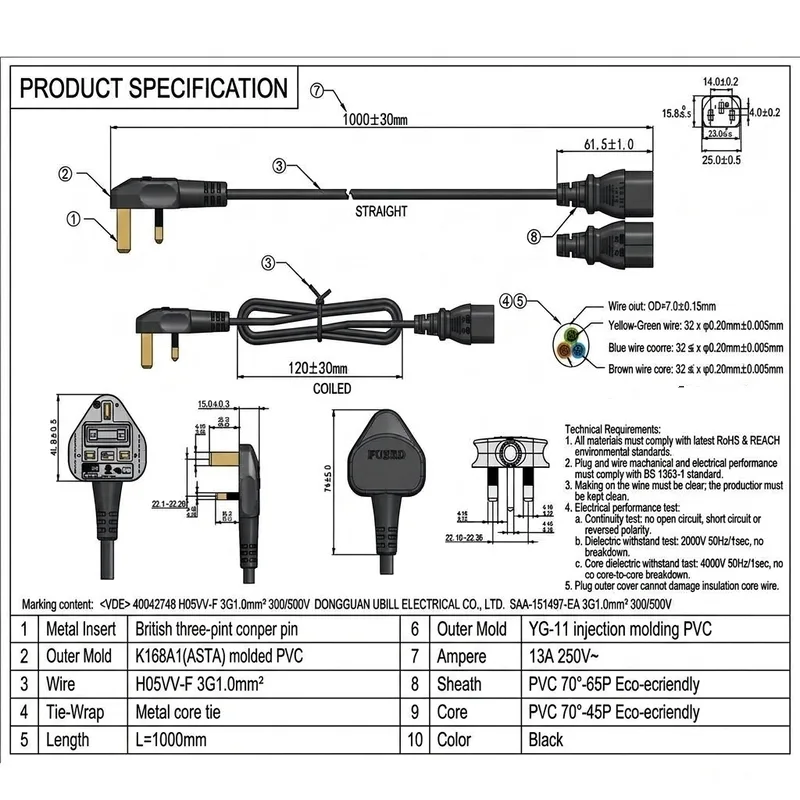
1. Verify the Plug Type and Applicable Standard
Confirm that the plug configuration is suitable for the intended UK market and that the supplier can provide relevant evidence of compliance for the exact model.
For products using a BS 1363 plug, ask for the applicable test reports or certification documentation and verify that the documents correspond to the product being purchased.
Avoid relying on a generic certificate that does not clearly identify the relevant model, construction, or product family.
2. Confirm Cable Specifications
Request a complete cable specification rather than relying on a general description such as “heavy-duty cable” or “high-quality copper wire.”
Key details may include:
- Conductor material and cross-sectional area
- Number of cores and cable construction
- Rated voltage and current
- Insulation and sheath materials
- Cable length and temperature rating
- Applicable product standards and supporting test records
These specifications should be consistent across the product drawing, quotation, technical data sheet, and delivered goods.
3. Check the Plug Fuse and Product Configuration
For UK plug products that require a fuse, confirm the fuse specification and its suitability for the product’s intended load and design.
The fuse, plug, cable, and connected equipment should be evaluated as part of the complete electrical configuration. A built-in fuse does not compensate for an incorrectly sized conductor or a non-compliant plug.
4. Review Testing and Quality Records
Before placing a bulk order, buyers should clarify what inspections and electrical tests are performed, when they take place, and how results are recorded.
Depending on the product and applicable requirements, verification may include conductor and dimensional checks, continuity, polarity, insulation-related tests, and other required safety tests.
The appropriate test plan depends on the specific product. Buyers should agree on acceptance criteria and required documentation before mass production.
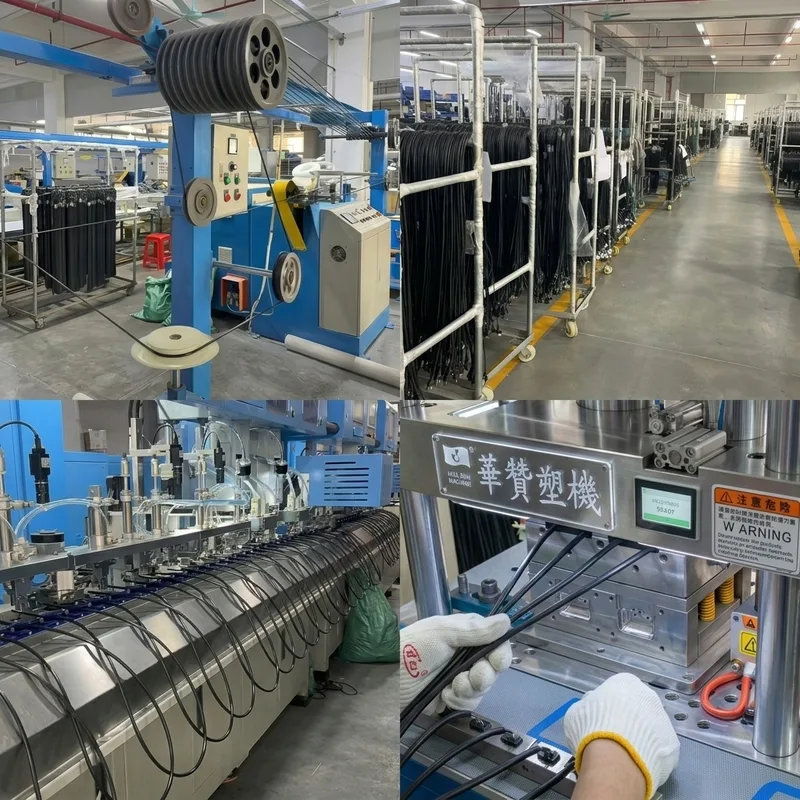
Why Manufacturing Process Control Matters
A finished power cord depends on more than the quality of its plug or cable material. Consistency across wire processing, cable production, plug molding, assembly, testing, and packaging also matters.
An integrated manufacturing process can help a supplier maintain closer control over materials, production specifications, and inspection procedures. However, in-house manufacturing alone does not prove compliance; product-specific verification and appropriate test records remain essential.
When assessing a power cord manufacturer, buyers can ask:
- Are conductor materials and cable specifications checked against the approved requirements?
- Are plug components and molded parts inspected during production?
- Are electrical tests performed according to the product’s requirements?
- Can the supplier provide traceable inspection records for the relevant model or production batch?
- Are changes to materials or components reviewed before production?
Clear answers to these questions help buyers evaluate whether a supplier’s quality system is suitable for their product and market.
Choosing a UK Power Cord Manufacturer for OEM and ODM Projects
For businesses developing or sourcing power cords for the UK market, supplier selection should consider manufacturing capability, product consistency, customization requirements, and documentation.
SEBLIP is a power connection products supplier backed by over 20 years of factory experience and a 40,000 m² manufacturing facility in Dongguan, China. Its integrated production processes cover wire processing, cable production, injection molding, assembly, electrical testing, quality inspection, and final packaging.
SEBLIP supplies a range of power connection products, including power cords, extension cords, IEC connectors, power adapters, and plug components.
For B2B customers, OEM and ODM options can be discussed according to project requirements, including plug configurations, cable length, conductor specifications, wire type, product appearance, labeling, and packaging.
For UK-bound products, the exact plug design, ratings, applicable standards, and supporting documentation should be confirmed for the specific model before an order is finalized. Certification or compliance claims should be based on the relevant product and its valid documentation.
Key Takeaways for Power Cord Buyers
The October 2026 UK safety report shows how discrepancies between a product’s declared specifications and its actual construction can create significant safety concerns.
When sourcing UK power cords, buyers should focus on three priorities:
- Plug compliance: Verify that the plug meets the applicable requirements and that supporting documentation matches the specific product.
- Cable specification accuracy: Confirm that conductor size, materials, ratings, and cable construction match the approved specification.
- Documented quality control: Review relevant inspection records and test evidence instead of relying solely on product appearance or supplier claims.
For businesses sourcing power cords and related electrical connection products, SEBLIP supports OEM and ODM discussions based on specific product specifications and market requirements.
Source: UK Office for Product Safety and Standards, Product Safety Report: Xin Yue AC PC Power Cable (2610-0158), published 22 October 2026.
Frequently Asked Questions About UK Power Cord Safety
Q: What is BS 1363, and why is it important for UK power cords?
A: BS 1363 is a British standard covering plugs and socket-outlets used in the UK.
Q: Why is the conductor cross-sectional area important in a power cord?
A: The conductor cross-sectional area affects electrical resistance and current-carrying capability. An undersized conductor may generate more heat under the same current, potentially increasing the risk of overheating.
Q: What should buyers check before purchasing UK power cords in bulk?
A: Buyers should review the plug type, conductor material and cross-sectional area, rated voltage and current, cable construction, relevant compliance documents, and quality inspection records. The requirements should be confirmed for the specific product model and intended application.
Q: Does a fused UK plug guarantee that a power cord is safe?
A: No. A fuse provides overcurrent protection when correctly selected and used within the intended design, but it cannot compensate for an undersized conductor, a non-compliant plug, or other construction defects. The complete power cord assembly must meet the applicable safety requirements.
Q: Can SEBLIP customize UK power cords for OEM and ODM projects?
A: Yes. SEBLIP can discuss OEM and ODM requirements such as plug configurations, cable length, conductor specifications, wire type, product labeling, and packaging. The available options and applicable compliance requirements should be confirmed for each project.
Q: What is the MOQ for SEBLIP power cord orders?
A: The standard MOQ is 100 pieces. Customized projects may require separate confirmation depending on the product configuration, materials, and production requirements.
Q: Can I request a sample before placing a bulk order?
A: Samples can be arranged for evaluation. A sample fee applies, and the fee may be refunded with a bulk order subject to confirmation. Buyers can contact the SEBLIP team to confirm sample availability and arrangements.
Q: How long does production and delivery take?
A: In-stock products can generally be shipped within 7 days, while customized orders typically require around 25 days. Actual timing depends on product specifications, order quantity, and production arrangements, so the schedule should be confirmed before ordering.