
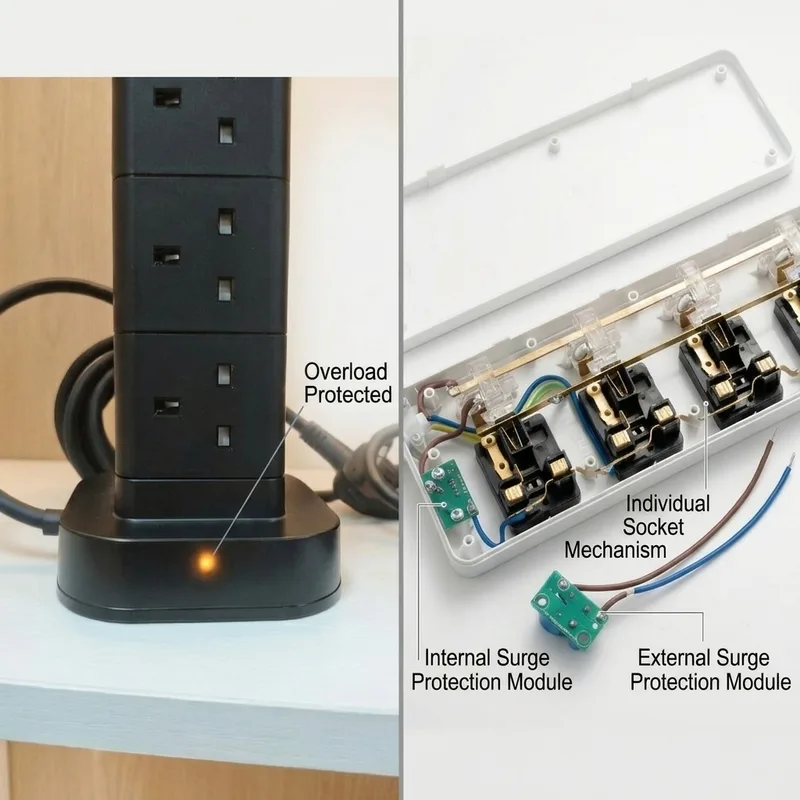
Household power strips make it easier to connect multiple electrical devices to a single power outlet. However, adding more outlets does not necessarily mean adding more electrical protection. Depending on the design, a power strip may include surge protection, overload protection, or both.
Understanding the difference between these features helps consumers choose a suitable power strip for home offices, entertainment systems, and everyday household electronics. For importers and brands sourcing household power strips, it is also important to verify the protective functions and electrical ratings of each product model.
In this guide, we explain how surge protection and overload protection work, how they differ, and what to consider when selecting a power strip for household use.
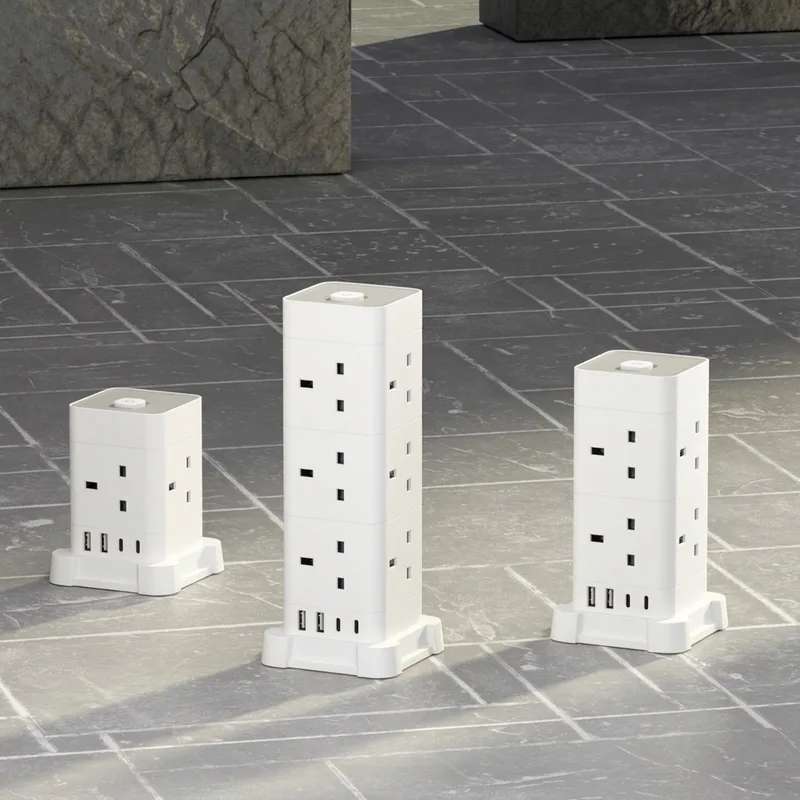
What Is Surge Protection in a Power Strip?
Surge protection is designed to reduce the impact of short-duration voltage spikes, also known as transient overvoltages, on connected electrical equipment.
These events can originate from switching operations within an electrical system, utility disturbances, or lightning-related activity. Even when a surge does not immediately destroy a device, repeated electrical stress may affect sensitive electronic components over time.
A standard power strip does not automatically provide surge protection. A surge protection power strip contains dedicated protective components designed to limit excessive transient voltage and dive
How Does Surge Protection Work?
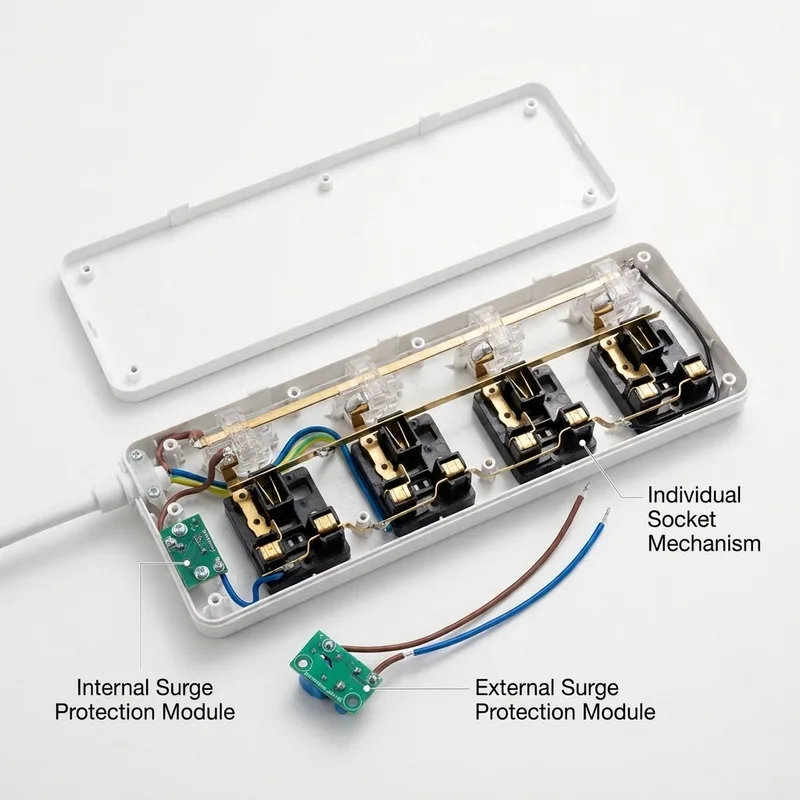
One commonly used component in surge protective devices is the metal-oxide varistor (MOV).
Under normal operating conditions, an MOV has a relatively high resistance. When a sufficiently high transient voltage occurs, its electrical resistance decreases, allowing it to conduct surge current and limit the voltage reaching the protected circuit.
The actual protection level depends on the component characteristics, circuit design, surge ratings, and condition of the protective device.
When comparing surge protection power strips, consider the following specifications:
- Surge rating: The manufacturer’s stated surge energy or current rating, where applicable, helps describe the device’s tested capability.
- Voltage protection level: This indicates the voltage level associated with the device’s specified protective performance under defined test conditions.
- Protection indicator: Some models include an indicator that shows whether the surge protection function remains available.
- Product safety documentation: Confirm the applicable standards, ratings, and test documentation for the exact model.
Surge protection may be useful for household electronics such as desktop computers, monitors, televisions, routers, and other sensitive equipment. However, the appropriate protection depends on the device, the electrical environment, and the specifications of the surge protector.
It is also worth remembering that surge protective components can degrade after repeated surge events. A protection indicator, when provided, should be interpreted according to the manufacturer’s instructions.
What Is Overload Protection in a Power Strip?
Overload protection addresses excessive current flowing through a power strip when the connected electrical load exceeds its permitted capacity.
For example, a user may connect a heater, kettle, and other high-power appliances to the same power strip. If their combined demand exceeds the product’s rated capacity, the resulting current may cause excessive heating in the cable, terminals, and internal connections.
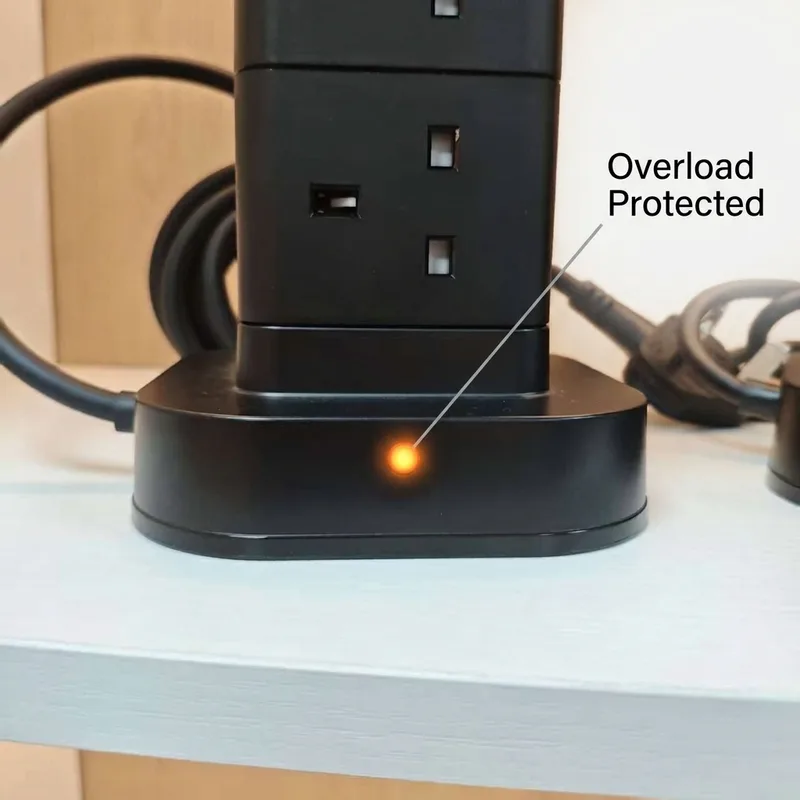
A power strip with overload protection may incorporate a resettable circuit breaker, a suitable fuse, or another protective mechanism, depending on its design.
How Does Overload Protection Work?
When the current exceeds the protection device’s operating threshold for the specified duration, the device interrupts the circuit or disconnects the load.
The response depends on the protective device’s rating and operating characteristics. It is not necessarily instantaneous at every current above the nominal rating.
For household use, buyers should check:
- Rated current: The maximum permitted current must be suitable for the intended application and destination market.
- Maximum load: The total connected load must remain within the product’s specified limits.
- Protection mechanism: Confirm whether the model uses a circuit breaker, fuse, or another form of overcurrent protection.
- Cable and terminal design: Conductors, terminals, insulation, and internal connections must be suitable for the rated load.
- Safety compliance: Verify that the exact model meets the applicable product safety requirements.
Overload protection is an important safety feature, but it does not make it acceptable to exceed the power strip’s rated capacity. Users should still distribute high-power appliances appropriately and follow the manufacturer’s instructions.
3. Surge Protection vs. Overload Protection: What Is the Difference?
Surge protection and overload protection address different electrical conditions. Although both can contribute to electrical safety, neither should be assumed to replace the other.
| Comparison | Surge Protection | Overload Protection |
|---|---|---|
| Main purpose | Limits transient overvoltage | Interrupts excessive current |
| Typical electrical condition | Brief voltage spike | Excessive current over a specified period |
| Common mechanism | MOV or another surge protective component | Circuit breaker, fuse, or another overcurrent device |
| Potential benefit | Helps reduce voltage stress on connected electronics | Helps reduce risks associated with excessive current and overheating |
| Key specification | Surge ratings and voltage protection performance | Current rating and trip characteristics |
| Available on every power strip? | No | No |
For example, a voltage transient may occur without the connected load exceeding the power strip’s rated current. In this case, overload protection alone may not provide the intended surge protection.
Conversely, connecting too many high-power appliances can create an overload even when no voltage surge occurs. Surge protection alone does not replace an appropriately rated overcurrent protection mechanism.
The key point is simple: surge protection manages transient overvoltage, while overload protection addresses excessive current.
Can a Power Strip Have Both Surge and Overload Protection?
Yes. A household power strip can incorporate both surge protection and overload protection when its design includes the appropriate components and protective mechanisms.
Combining the two features can address different electrical risks within one product. However, their effectiveness depends on component selection, circuit design, ratings, and verification of the complete product.
For OEM and ODM projects, buyers should specify the required functions early in the development process. This allows the manufacturer to assess component availability, internal layout, electrical performance, testing requirements, and compliance documentation.
When evaluating a combined-protection power strip, confirm that both functions are explicitly specified and supported by the relevant product documentation. The presence of a circuit breaker does not establish that the product has surge protection, and the presence of an MOV does not establish that it has overload protection.
How to Choose a Power Strip: Standard, Overload-Protected, or Surge-Protected?
Choosing the right power strip depends on your connected devices, electrical load, and protection requirements.
- Standard Power Strip: Provides additional outlets for everyday electrical devices within its rated capacity, without dedicated surge protection or a separate overload trip mechanism.
- Power Strip with Overload Protection: Helps interrupt excessive current through a specified protective device, such as a circuit breaker.
- Surge Protection Power Strip: Helps limit transient voltage spikes that may affect sensitive electronics, such as computers, TVs, and routers.
Some power strips combine surge protection and overload protection in one product. Before purchasing, check the rated voltage, current, maximum load, cable specifications, and applicable safety requirements. The actual protection features depend on the product’s design and specifications.
OEM and ODM Household Power Strip Customization
SEBLIP provides power strips and extension leads in different configurations, with OEM and ODM customization available subject to product feasibility and applicable compliance requirements.
Customization options may include:
- Plug and socket configurations: UK, US, EU, Australian, and other market-specific designs.
- Outlet quantity and layout: Different numbers of AC outlets and conventional or vertical tower structures.
- USB charging: USB-A and USB-C options, subject to the selected charging specification.
- Cable specifications: Cable length, conductor size, cable type, and color.
- Housing design: Selected materials, colors, dimensions, and product appearance.
- Protection features: Surge protection, overload protection, or both, where supported by the design.
- Branding and packaging: Logo printing, product labels, and customized packaging.
SEBLIP — Your Power Strip Manufacturing Partner
SEBLIP offers household power strips and extension leads in different configurations, with OEM and ODM customization options for various market requirements. Customized specifications are confirmed based on the intended application, electrical ratings, component design, and applicable compliance requirements.
With over 20 years of factory experience and a 40,000 m² manufacturing facility, SEBLIP integrates wire processing, cable production, injection molding, assembly, electrical testing, quality inspection, and final packaging.
Beyond power strips, our product range includes power cords, extension cords, power adapters, and plug components for different markets.
Explore SEBLIP’s power strips and extension leads to compare available configurations and discuss your OEM or ODM requirements.

Frequently Asked Questions
Q:What is the difference between surge protection and overload protection in a power strip?
A:Surge protection helps limit brief voltage spikes, while overload protection interrupts excessive current under specified conditions. They serve different purposes, and some power strips include both features.
Q:Does every power strip have surge or overload protection?
A:No. Standard power strips may provide additional outlets without dedicated surge protection or a separate overload protection mechanism. Always check the product specifications to confirm which features are included.
Q:Which power strip is best for home use?
A:The right household power strip depends on your connected devices and electrical load. Standard models suit many everyday applications, while surge-protected models may be appropriate for sensitive electronics. Overload protection provides an additional safeguard against excessive current when properly specified.
Q:Can I connect high-power appliances to a power strip?
A:Only if the combined load stays within the power strip’s rated voltage, current, and maximum power limits. High-power appliances, such as heaters and kettles, require particular attention to their electrical requirements. Never exceed the manufacturer’s specified ratings.
Q:Can SEBLIP customize power strips with surge and overload protection?
A:Yes. SEBLIP supports OEM and ODM customization for power strips, including outlet configurations, plug types, cable specifications, housing designs, and protective features where technically feasible. Fin