
Walk into any high-volume salon, and you will see stylists fighting their equipment. Flat irons get spun 360 degrees multiple times a minute. Hot air brushes twist continuously. Hair dryer cables wrap around chairs, wrists, and styling stations. When a manufacturer specs a standard, static power cable for a professional styling tool, they are programming a failure point right at the base of the handle. Within months, the internal copper strands snap from repeated torsion, or the PVC jacket shears off completely.
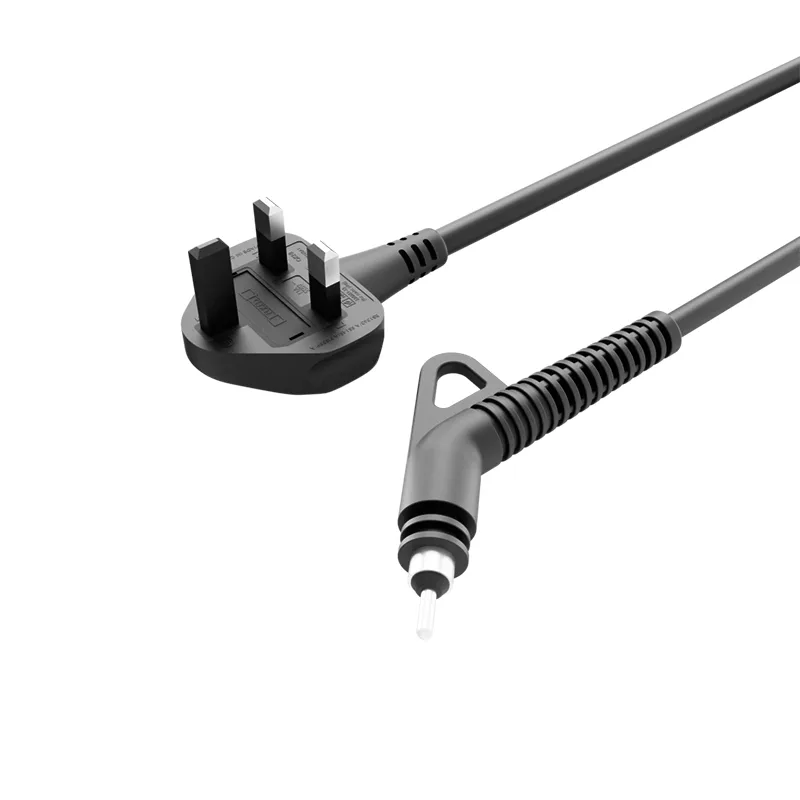
The operational fix is a 90-degree swivel power cord. Sourcing these specialized components from a dedicated manufacturer allows appliance brands to match the cord’s flexibility, rotation mechanism, and electrical rating directly to the tool’s intended use, drastically reducing warranty claims driven by broken connections.
Operational Demands of Professional Salon Equipment
A standard household appliance sits on a counter. A professional hair straightener travels through the air for eight hours a day. The cord drags across chemical spills, endures high ambient heat, and takes sudden yanks when a stylist accidentally steps on a loop.
Appliance designers have to account for extreme torsion fatigue. Every time a user flips a curling iron to wrap a section of hair, they introduce a twist into the cable. If the base connection is rigid, that twist travels down the line and accumulates. The cable eventually kinks. Repeated kinking focuses severe mechanical stress on a single point, breaking the internal conductors one strand at a time. We see this failure mode constantly in cheap aftermarket tools—the appliance still powers on intermittently if you hold the cord at a specific angle, a clear sign of internal wire breakage.
To survive this environment, cords require a highly specific 2-core flexible construction. The outer jacket relies on a high-flexibility PVC compound. This material needs enough give to bend sharply without cracking under tension, yet enough chemical resistance to withstand daily exposure to hairspray, acetone, and salon solvents that degrade standard plastics. Inside, the pure copper conductors must be stranded finely enough to tolerate thousands of flex cycles. Solid core wire or low-strand-count wire will fail rapidly under these conditions.
Mechanics of the 90-Degree Anti-Tangle Swivel
A swivel cord does not just spin. It actively redirects physical stress away from the critical joint where the wire meets the appliance. By angling the cable exit at 90 degrees from the tool’s base, the mechanism allows the cord to hang naturally downward toward the floor, regardless of how the operator angles the handle.
Rotation introduces a severe mechanical challenge. You have live electrical current passing through a joint that is constantly moving. The engineering required to make this safe and reliable dictates the entire design of the tool’s base.
Maintaining Electrical Continuity During Rotation
Inside the swivel assembly, static wiring meets rotating contacts. This is typically achieved through a slip ring or concentric brass contact system. The internal wires of the appliance connect to stationary metal rings. The prongs from the moving cord housing maintain physical pressure against those rings as the user spins the tool.
If the contact pressure is too light, the connection suffers micro-interruptions. This causes arcing, heat buildup, and eventually a melted plastic housing. If the pressure is too tight, the swivel binds. The stylist goes back to fighting the cord, entirely defeating the purpose of the component. The primary engineering trade-off here is physical space. A reliable swivel mechanism requires a slightly longer or wider handle base to accommodate the internal rings, the spring tensioners, and the necessary electrical clearance between the live and neutral paths to prevent short circuits.
AI-Driven Quality Control in High-Volume Manufacturing
You cannot visually inspect a finished swivel joint for internal friction or microscopic contact gaps. High-volume production relies on automated, continuous testing. A dedicated UK swivel power cord manufacturer puts batches through motorized rotation jigs monitored by automated diagnostic software.
These machines clamp the cord and spin it tens of thousands of times while running a continuous test current through the line. An automated optical inspection (AOI) system monitors the physical assembly, while electrical sensors log any drop in voltage or spike in resistance. A resistance spike during rotation instantly flags a failing slip ring assembly. This level of rigorous, data-driven quality control separates professional OEM components from generic replacements that short out after a few weeks on the salon floor.
Power Cord Requirements by Styling Tool Category
Not every hair tool needs the same cable specification. Brands must match the cord’s gauge and flexibility to the appliance’s thermal output and usage pattern. Getting this wrong leads to either an unnecessarily heavy tool or a dangerous fire hazard.
Flat Irons and Hair Straighteners: These require the highest degree of maneuverability. The 90-degree swivel is non-negotiable. Because straighteners typically draw lower amperage (often under 500 watts), the 2-core cable can use a thinner gauge, such as 0.75mm². This keeps the cord lightweight, reducing operator wrist fatigue during long styling sessions.
Hot Air Brushes: These tools see continuous, rapid rotation. The user literally rolls the brush through the hair, spinning the handle constantly. The swivel mechanism here must offer near-zero resistance. Any drag in the rotation joint translates directly to physical strain for the user and risks tangling the cord entirely.
Hair Dryers: Professional dryers draw massive current, frequently peaking between 1800 and 2200 watts. This requires thicker pure copper conductors, often 1.0mm² or 1.5mm², to handle the load without overheating. Thicker copper means a stiffer cable. While a full 360-degree swivel is less common on heavy dryers due to the sheer size of the required high-amperage contacts, heavy-duty strain reliefs and highly flexible PVC jackets are mandatory to prevent the heavy cord from tearing out of the housing when dropped.
Sourcing Multi-Region Plug Configurations
Appliance brands rarely build for a single country. An OEM project might dictate shipping identical flat irons to London, New York, and Sydney, differing only by their power connection. Managing this at the assembly level requires a custom appliance power cord supplier capable of molding multiple plug standards onto the same base swivel cord.
Adapting BS1363 and International Plugs for Global Markets
The British Standard BS1363 plug presents a unique manufacturing challenge. It is notoriously bulky, houses a physical fuse, and requires specific pin dimensions and grounding configurations. Even on 2-core double-insulated appliances—where no true earth connection exists—the plug still requires a plastic dummy earth pin just to open the safety shutters on UK wall sockets.
Adapting a sleek, lightweight salon tool to accept a heavy UK plug changes the weight distribution of the packaged product. A competent UK swivel power cord manufacturer accounts for this during the injection molding process. They ensure the strain relief at the plug end can handle the mass of the plug itself when the cord is inevitably dropped or yanked from the wall.
For EU (Type C/F), US (Type A/B), and AU (Type I) markets, the plug molds are physically lighter. However, the jacket printing, internal wire colors, and insulation ratings must shift to meet local CE, UL, or SAA regulatory standards. Sourcing all these regional variations from a single factory ensures the actual swivel mechanism—the critical failure point—remains identical and reliable across your entire global product line.
Partnering with a Factory-Direct OEM Supplier
Selecting a component supplier dictates the lifespan of your appliance. When a styling tool dies because the cord shorts out, consumers blame the brand printed on the handle, not the factory that molded the plug. Standard off-the-shelf cables will not survive the mechanical stress of a salon environment.
Working directly with an OEM and ODM manufacturer like SEBLIP gives you absolute control over the exact specifications that dictate cord longevity. You dictate the copper purity, the PVC flexibility rating, the wire gauge, and the specific rotational resistance of the swivel joint. If your current assembly partner treats power cords as a generic afterthought, you are absorbing unnecessary warranty claims and damaging your brand’s reputation with professional stylists.
Evaluate your returns data. If base-level cord failures, twisted jackets, or intermittent power drops are driving replacements, it is time to spec a purpose-built solution. Upgrading your assembly process with a custom SEBLIP UK Swivel Power Cord ensures your power connection survives the brutal realities of daily salon use.