
A UK cloverleaf power cord is a detachable AC cord with a UK BS 1363 three-pin plug at one end and an IEC 60320 C5 appliance connector at the other. The C5 connector mates with a C6 inlet commonly found on laptop power adapters, projectors, audio products and other relatively low-power equipment. It supplies mains power; it does not convert voltage, frequency or output voltage.
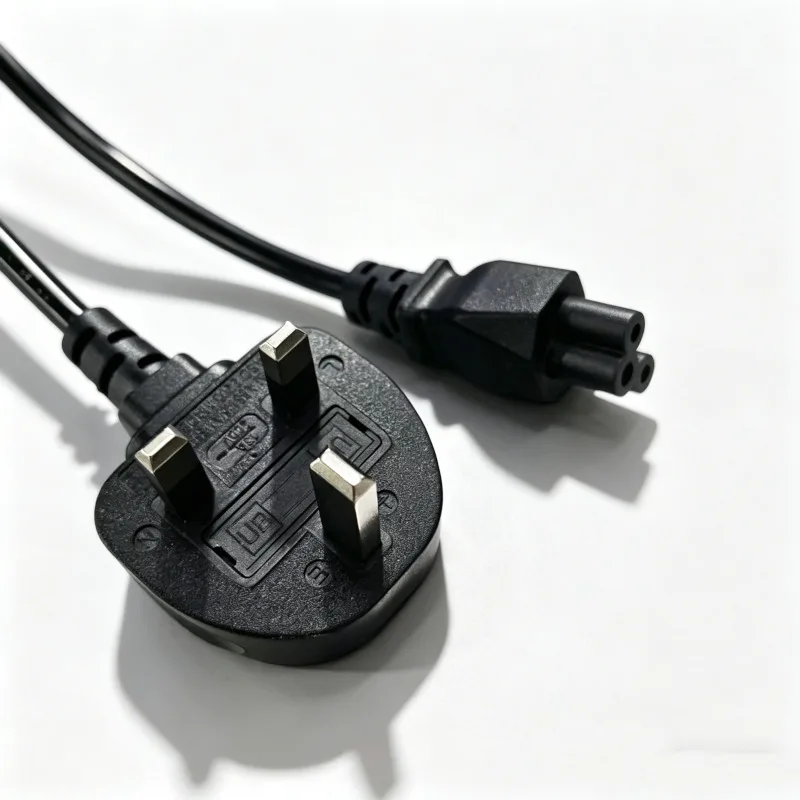
A UK cloverleaf power cord connects a UK wall socket to equipment with an IEC 60320 C6 inlet
The equipment side is the key identification point. An IEC C5 connector has three rounded lobes: line and neutral sit in the lower positions, while the protective-earth contact occupies the upper center position. It plugs into a matching male C6 inlet on the equipment or external power supply.
At the wall end, a UK cloverleaf power cord uses the familiar rectangular-pin BS 1363 format. The plug includes a replaceable fuse and is intended for compatible UK sockets. That makes the complete assembly a BS 1363-to-IEC C5 cordset, not simply a generic laptop cable.
Physical fit is only the first check. The equipment nameplate must accept the local mains supply, and the cord assembly must have suitable voltage, current, conductor, temperature and safety ratings. A cord can fit perfectly while still being wrong for the electrical load or destination market.
“Cloverleaf” and “Mickey Mouse” describe the IEC C5 connector, not the UK plug standard
“Cloverleaf” and “Mickey Mouse” are trade nicknames based on the connector’s three-lobed shape. Both usually refer to the IEC C5 female connector, although neither nickname is a formal standard designation.
The wall plug can change while the C5 end remains the same. A US cord may combine a NEMA plug with an IEC C5 connector; a UK version combines BS 1363 with C5. Buyers who specify only “Mickey Mouse cable” risk receiving the wrong wall plug. A purchase description should identify both ends: BS 1363 plug to IEC 60320 C5 connector.
Typical applications—and the checks that determine whether the cord is compatible
IEC C5 cords are associated with portable electronics, but application names aren’t reliable enough for purchasing. Two laptop adapters from the same brand may use different inlets. Inspect the inlet, read the electrical label and confirm the manufacturer’s documentation before ordering a replacement or production quantity.
Laptop adapters, projectors, audio equipment, and compatible small appliances
Common uses include laptop AC adapters, compact projectors, powered speakers, some monitors, instrument equipment and selected small appliances. In equipment-bundling programs, a UK cord lets a manufacturer ship the same compatible power supply with a market-specific mains lead.
| Check | What to verify |
|---|---|
| Equipment inlet | It is an IEC C6 inlet, not a similar-looking C8 or C14 inlet. |
| Input label | The device or adapter accepts UK mains voltage and frequency. |
| Electrical rating | The complete cordset rating meets the connected load and operating conditions. |
| Cable construction | Conductor size, jacket material, temperature rating and length suit the application. |
For replacement sales, connector photos help, but the inlet designation and nameplate remain better evidence. For OEM orders, the approved bill of materials should define the plug, fuse, cable and connector rather than relying on a product nickname.
Cases that require a different appliance connector, wall plug, or cable specification
Do not use C5 for an IEC C8 “figure-eight” inlet, an IEC C14 inlet that requires a C13 cord, or higher-current equipment designed around another connector family. The shapes are intentionally different and shouldn’t be modified to fit.
A BS 1363 plug is also the wrong choice where the destination uses US, Australian or continental European outlets. Outdoor exposure, high temperatures, repeated flexing, medical settings and industrial environments may require cable constructions or approvals beyond an ordinary indoor cord. Extension leads and plug adapters don’t correct an unsuitable cord rating.
Why US buyers source BS 1363-to-IEC C5 cords for UK-bound equipment rather than standard US outlets
US buyers generally need these cords for products being exported, installed or supported in the United Kingdom. A standard US plug won’t mate directly with a BS 1363 socket, and adding a travel adapter creates another connection point while leaving fuse, grounding and compliance questions unresolved.
The cleaner approach is to bundle the correct market cord with equipment whose power input is already suitable for UK mains. Many laptop adapters accept a broad input range, but you should never assume that from the product category. Read the exact adapter label.
Distributors also source BS 1363-to-IEC C5 cord options for replacement programs. Consistency matters here: an undocumented substitution in fuse rating, conductor size, connector molding or cable length can turn a routine replenishment order into a new technical review.
Fuse and compliance questions require evidence for the exact cord configuration
A UK plug’s fuse and compliance status must be assessed as part of the quoted assembly. Connector appearance doesn’t establish the safe fuse choice, and a test report for one cable construction shouldn’t automatically be applied to another length, conductor specification or plug component.
Can the fuse be selected from the connector shape alone?
No. The C5 shape identifies the mating interface, not the equipment’s current demand or the cable’s permissible load. Fuse selection should account for the equipment manufacturer’s requirements, normal operating current, inrush behavior, cable construction and applicable UK plug rules.
The fuse in a BS 1363 plug primarily protects the flexible cord and downstream connection against overcurrent. Specifying an unnecessarily high fuse can reduce that protection; specifying one too low can cause nuisance operation during startup. Ask the equipment engineer to approve the fuse rather than copying a value from an unrelated laptop lead.
Which standards, approvals, and test records apply to the quoted cable?
The quotation should identify the standards applied to each relevant component and the complete cordset. Typical references include BS 1363 for the UK plug format, BS 1362 for the plug fuse and IEC 60320 for the C5 appliance connector. Cable requirements and market approvals depend on the exact construction and sales channel.
Request traceable documents for the configuration being purchased: component certificates where applicable, test reports, rating details, conductor and insulation specifications, plug and connector drawings, and production inspection criteria. Check that model numbers and ratings on the documents match the sample and quotation. A logo shown on a catalog page isn’t enough evidence for every possible customized assembly.
SEBLIP quotation checklist: inlet, electrical requirements, fuse, cable, customization, quantity, and packaging
SEBLIP manufactures power cords and customized cable assemblies in Dongguan, China for wholesalers, distributors, equipment brands and project buyers. To request a comparable, technically useful quote for a custom UK IEC C5 power cord, provide:
- Equipment interface: confirmation that the product has an IEC C6 inlet.
- Electrical requirements: equipment input rating, expected load and operating environment.
- Plug and fuse: BS 1363 plug requirement and the approved fuse specification.
- Cable: required length, conductor cross-section, jacket type, color and printing.
- Connector: IEC C5 configuration plus any dimensional or molding requirements.
- Evidence: required standards, approvals, test records and sample-validation process.
- Commercial details: forecast quantity, order quantity, labeling, individual packing, carton marking and delivery destination.
A quote that leaves the fuse, conductor construction or compliance documents undefined isn’t ready for approval, even if both connector ends are correct.