
A standard C13 C14 10A 250V power cord is specified to carry a maximum of 10 amps of current at up to 250 volts, strictly adhering to the IEC 60320 standard. Its baseline construction relies on three pure copper conductors—typically sized at 3G1.5mm² for international environments or 14 to 18 AWG in the US market—sheathed within a flexible PVC jacket. These jumper cables serve as the primary power link between rack-mounted IT hardware and a Power Distribution Unit (PDU).
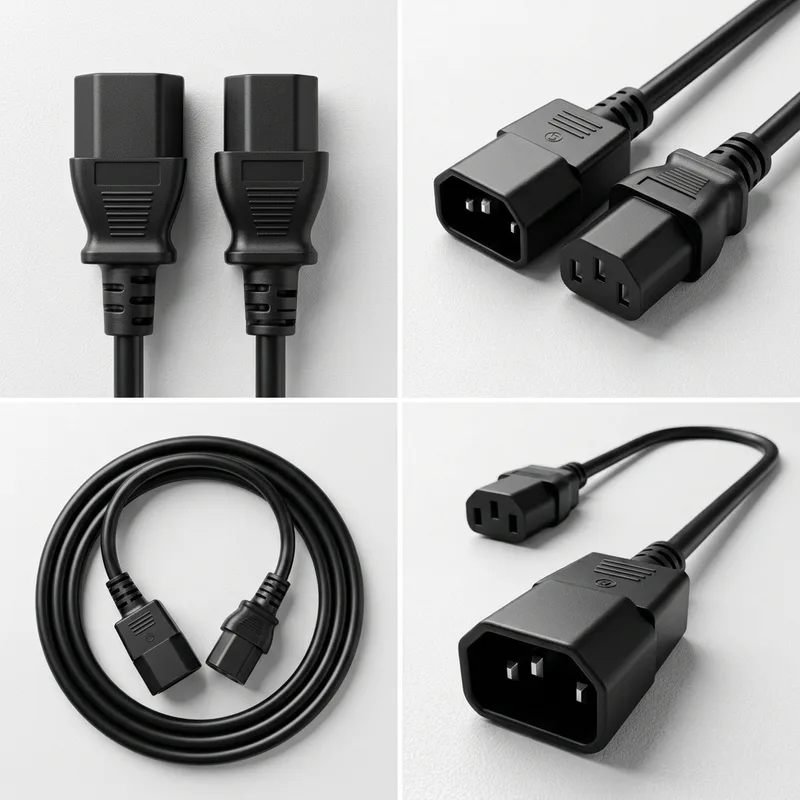
Core Electrical Ratings and Conductor Materials
10A 250V Load Capacity Under IEC 60320
The IEC 60320 standard governs the physical dimensions and electrical thresholds for appliance couplers operating up to 250 volts. The C13 line socket and the C14 plug inlet form a specific mated pair engineered for cold conditions, defined by a maximum pin temperature of 70°C. The voltage rating easily accommodates both US 120V and European 230V systems without modification.
The strict 10-amp limit dictates how these cords are deployed. Pushing more than 10 amps of continuous draw through a standard C13 connector invites thermal failure at the plug interface. Data center engineers must calculate the total draw of the connected server or switch to ensure it falls safely below this 10A ceiling. Running higher voltage (240V vs 120V) allows the same cord to deliver twice the total wattage to the equipment while remaining safely under the 10-amp current limit.
3G1.5mm2 Pure Copper and US AWG Equivalents
Specifying the correct wire gauge prevents hazardous voltage drop over the length of the run. In regions relying on metric specifications, a 10A 250V power cord almost exclusively uses 3G1.5mm² wire. The “3G” designation indicates three conductors, with one specifically marked by green/yellow insulation for the ground (earth), while each conductor features a cross-sectional area of 1.5 square millimeters.
For US buyers evaluating these same cables, 3G1.5mm² roughly translates to 14 AWG or 16 AWG depending on the application and safety margins required. Standard 3-foot to 6-foot server rack jumpers typically utilize 16 AWG or 18 AWG to comfortably handle a 10A load. However, for longer runs crossing a facility floor, stepping up to a thicker 14 AWG conductor mitigates electrical resistance and keeps voltage delivery stable at the equipment inlet.
Classifying Jumper Cables by Infrastructure Application
Standard Office IT and Peripheral Connections
Outside the controlled environment of a data center, IEC 320 jumper cables act as direct power leads for standard office hardware. Desktop PCs, professional dual-monitor setups, and heavy-duty network printers almost universally accept a C13 connection.
In office deployments, physical durability and bend radius take priority over precise length matching. Cables are routinely crushed against walls, routed tightly through desk grommets, or rolled over by office chairs. The PVC jacket must withstand this daily abrasion without compromising the internal copper strands or exposing live voltage.
High-Density PDU Cable Management Trends for 2026
Inside a modern server cabinet, excess cable length acts as a physical barrier. Coiled power cords block exhaust fans, trap hot air, and force cooling systems to work harder. Data center operators now abandon the generic 2-meter lengths of the past, instead specifying jumper cords in exact 1-foot, 2-foot, or 3-foot increments to map perfectly from the server inlet to the vertical PDU.
Visual identification is also shifting. Rack densities are increasing heading into 2026, making power feed tracing highly complex. Colored PVC jackets—often red and blue—are rapidly replacing standard black cords to map redundant A and B power feeds at a glance. This visual separation prevents an engineer from accidentally unplugging the primary power source while attempting to service a backup circuit.
Thermal and Conductive Properties of Pure Copper and PVC Jackets
Copper Clad Aluminum (CCA) frequently appears in budget cables, but it fails under the sustained loads of enterprise IT environments. CCA conductors possess higher electrical resistance than pure copper, which generates localized heat when a server draws heavy current. This resistive heating degrades the insulation over time.
SEBLIP manufactures these cords exclusively with 100% pure copper conductors. Pure copper maintains superior thermal stability, ensuring the cable does not soften or degrade even when operating near its 10-amp limit in a 40°C hot aisle.
The outer jacket relies on flexible Polyvinyl Chloride (PVC). PVC provides excellent dielectric insulation while keeping manufacturing costs viable for bulk orders. It bends easily to accommodate the tight routing required in high-density PDU layouts, absorbing mechanical stress before it reaches the copper core. Depending on the target market, this PVC construction will carry specific regional designations, such as SJT or SVT for UL listings in North America, or H05VV-F for VDE certification in Europe.
Deployment Limits for 10A C13 Connectors
Recognizing High-Draw Equipment Requiring C19/C20 Alternatives
Equipment upgrades frequently expose the limitations of existing power infrastructure. A standard 1U application server fits comfortably within the 10A budget of a C13 to C14 jumper cable. However, blade server chassis, large enterprise core switches, and facility-scale uninterruptible power supplies (UPS) routinely draw 16 to 20 amps.
Attempting to power these high-draw devices with a C13 connector is physically impossible by design. The IEC 60320 standard alters the pin configurations specifically to prevent this mistake. High-draw applications require C19 to C20 cables. The C19 socket features larger, horizontal rectangular pins and relies on thicker 12 AWG or 2.5mm² conductors to safely carry 16A or 20A loads. Buyers must audit their equipment inlets—if the socket has horizontal rather than vertical slots, a standard C13 cord will not fit, and forcing an adapter invites an immediate fire hazard.
Specifying Bulk OEM Orders for Server Racks
Sourcing cables for a new facility requires matching exact cord specifications to the physical rack layout. Working directly with an OEM C13 C14 power cord manufacturer allows data center engineers to bypass generic retail sizes. You can dictate cable lengths down to the inch, select specific jacket colors for phase balancing, and ensure the correct wire gauge for the target amperage.
SEBLIP operates a 40,000 square meter facility in Dongguan, utilizing automated assembly lines to produce these exact configurations. By controlling the extrusion of pure copper conductors and PVC jackets in-house, the factory delivers consistent, VDE and UL-compliant IEC 320 jumper cables for global project engineers and distributors.
For large-scale PDU to IT equipment deployments, success relies on three variables: specifying 100% pure copper construction to avoid resistive heating, ordering precise lengths to maintain unobstructed rack airflow, and verifying that your equipment will not exceed the 10A 250V load capacity of the C13 standard.