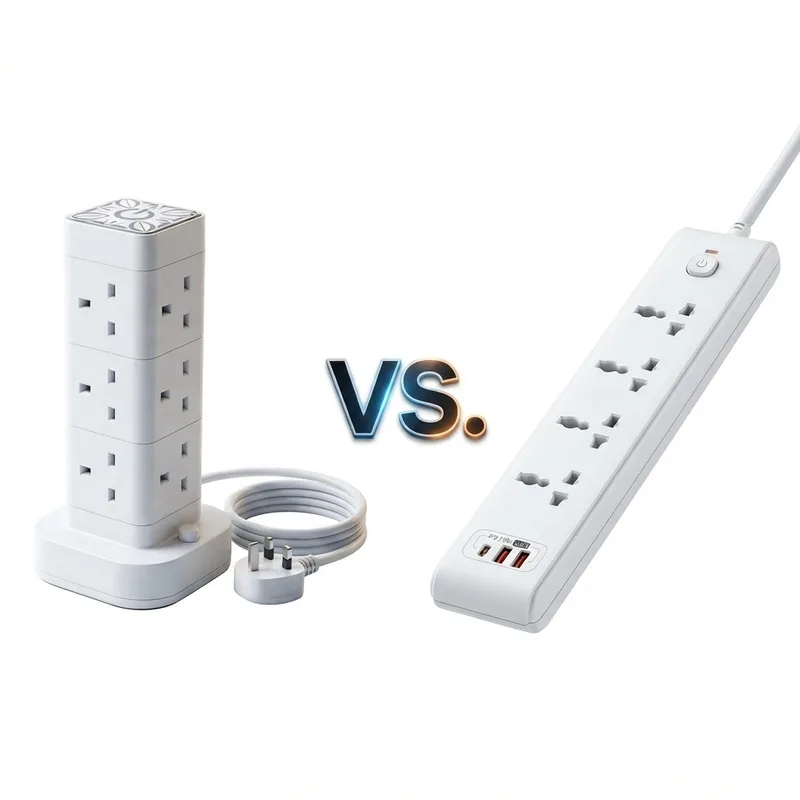
Power strips are widely used in homes, offices, workstations, and commercial environments to connect multiple electrical devices from a single power source. However, not all power strips use the same design.
The two common designs are tower power strips and traditional power strips. Their main differences are in structure, socket arrangement, space usage, and application scenarios.
For distributors, importers, electrical brands, and other B2B buyers, understanding these differences can help when selecting the right power strip for a specific market and application.
What Is a Tower Power Strip?
A tower power strip uses a vertical structure, with multiple outlets arranged around or along the tower body. Some models also include USB charging ports, individual or master switches, and other features depending on the product design.
Because the outlets can be distributed across different sides, a tower design can provide multiple connection points while using a relatively small footprint.

What Is a Traditional Power Strip?
A traditional power strip generally uses a horizontal bar-shaped housing, with multiple sockets arranged along the main body.
This familiar design is widely used for desks, home appliances, office equipment, and general electrical applications. Depending on the model, it can also include switches, USB ports, different cable lengths, and customized socket configurations.
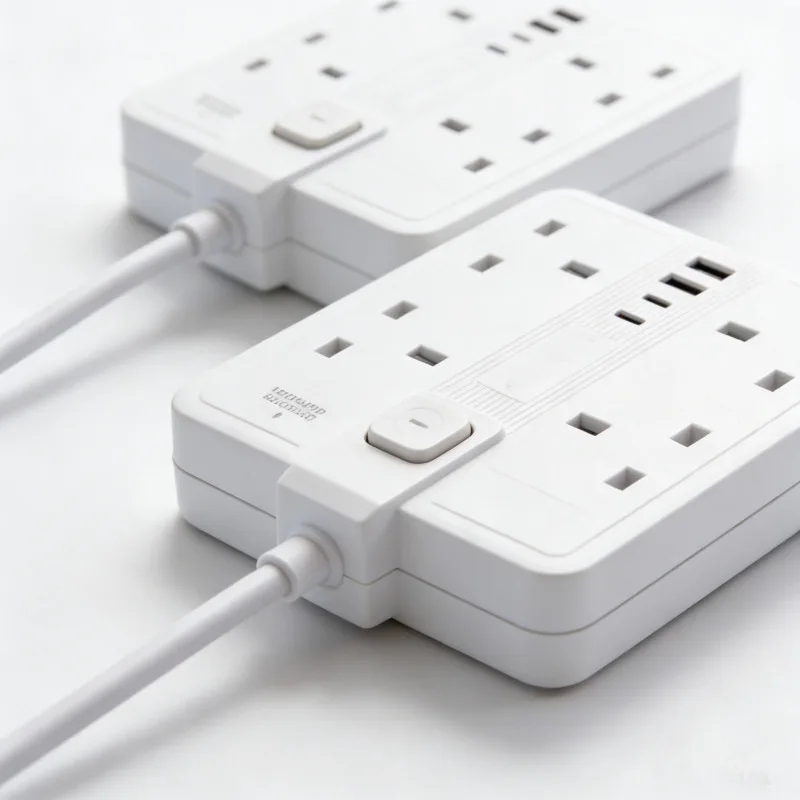
Tower Power Strip vs. Traditional Power Strip
| Feature | Tower Power Strip | Traditional Power Strip |
|---|---|---|
| Housing Design | Vertical / tower structure | Horizontal / bar structure |
| Socket Arrangement | Multiple sides or vertical layout | Mainly arranged along the body |
| Space Usage | Compact footprint | Requires more linear space |
| Access to Outlets | Can provide access from different directions | Mainly accessed from one side |
| Cable Organization | Can help reduce cable concentration around one area | Cables are usually distributed along the strip |
| Suitable Applications | Workstations, desks, offices, entertainment areas | Homes, offices, workshops, general use |
| Available Configurations | Depends on model | Depends on model |
| OEM & ODM | Available for customized designs | Available for customized designs |
Advantages of a Tower Power Strip
1. Compact Vertical Design
The vertical structure can reduce the amount of desk or floor space occupied by the power strip. This can be useful where horizontal space is limited.
2. Multi-Side Outlet Access
On models with outlets positioned around the tower, users can connect devices from different directions instead of concentrating every plug on one surface.
3. Convenient for Multiple Devices
A tower configuration can provide several connection points within a relatively compact housing, making it suitable for workstations, desks, and other areas with multiple electrical devices.
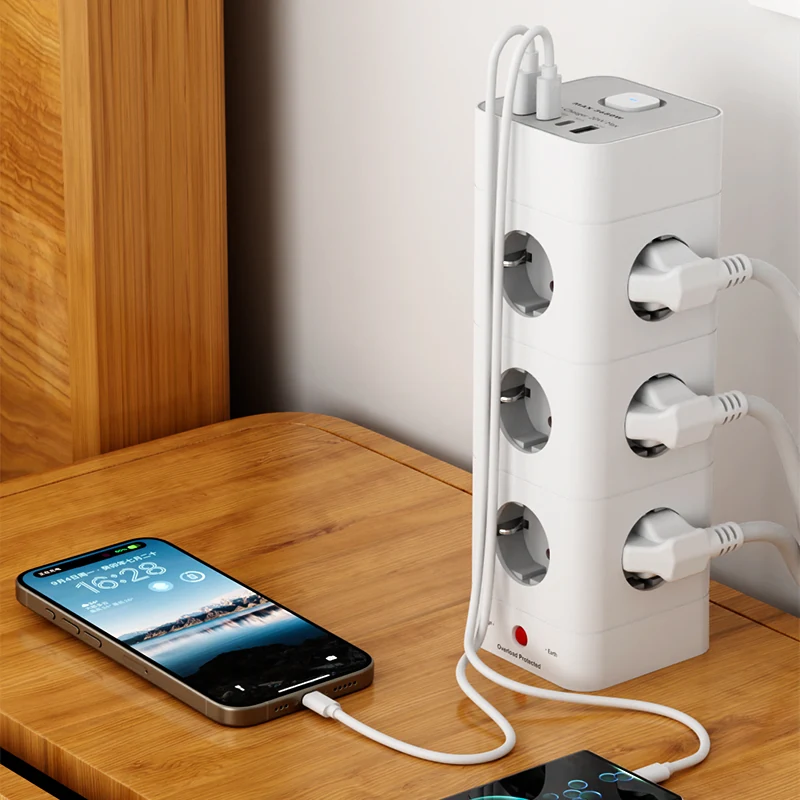
Flexible Product Configuration
Depending on the design, tower power strips can be developed with different outlet quantities, USB charging ports, switches, cable lengths, colors, and other features.
Advantages of a Traditional Power Strip
1. Familiar and Simple Design
The horizontal bar design is widely recognized and easy to use for everyday electrical connections.
2. Easy Placement
Traditional power strips can be placed along desks, floors, workbenches, entertainment units, and other horizontal surfaces.
3. Different Socket Configurations
Depending on the target market, traditional power strips can be designed with different socket numbers, plug types, cable specifications, USB ports, and switches.
4. Suitable for General Applications
The straightforward design makes traditional power strips suitable for many home, office, commercial, and workshop applications.

Tower or Traditional: Which One Should You Choose?
There is no single design suitable for every application.
A tower power strip may be considered when space efficiency, multi-side access, and vertical organization are important.
A traditional power strip may be more suitable when a horizontal layout, familiar operation, and flexible placement along a desk or work surface are preferred.
For B2B buyers, the decision should also consider the target market, plug type, socket configuration, electrical rating, cable specification, product dimensions, and applicable compliance requirements.
Different Markets Require Different Power Strip Designs
The housing structure is only one part of choosing a power strip. The plug and socket configuration must also match the target market and product requirements.
SEBLIP supplies power strips for different markets and product applications, including:
- UK Power Strips with UK-standard socket configurations
- US Power Strips for compatible US-market applications
- EU Power Strips with compatible European socket configurations
- Tower Power Strips for space-conscious applications
- Traditional Power Strips in different configurations
- OEM & ODM Power Strips with customized designs
Different products can be developed with variations in socket quantity, cable length, cable specification, color, USB configuration, switch design, housing structure, and packaging, depending on the project requirements.
What Should B2B Buyers Confirm Before Ordering?
Before sourcing a power strip, buyers should confirm:
- Target market and plug type
- Socket configuration
- Number of outlets
- Rated voltage and current
- Cable specification and length
- USB charging requirements
- Switch configuration
- Housing material and color
- Required certifications or compliance
- Packaging and OEM requirements
Choosing the right combination of structure and electrical configuration is important for developing a power strip suitable for the intended market and application.
SEBLIP Power Strip Solutions
SEBLIP provides tower and traditional power strips for different international markets, supporting distributors, wholesalers, importers, electrical brands, and manufacturers.
With 20+ years of manufacturing experience and a 40,000 m² manufacturing facility, SEBLIP supports OEM & ODM projects from product design and specification confirmation to customized production.
Whether you need a UK power strip, US power strip, EU power strip, tower power strip, or customized power strip, product specifications can be developed according to your target market and application requirements