Choosing the right power cord length may seem simple, but cable length can affect installation, cable management, voltage drop, product cost, and overall usability.
Whether you are sourcing power cords, extension cords, or customized cable assemblies for electrical equipment, choosing the right length is about more than simply making the cable long enough.
A practical approach is to select a length that provides sufficient reach without creating unnecessary excess cable. For longer runs and higher-current applications, cable length should also be considered together with conductor size and electrical load.
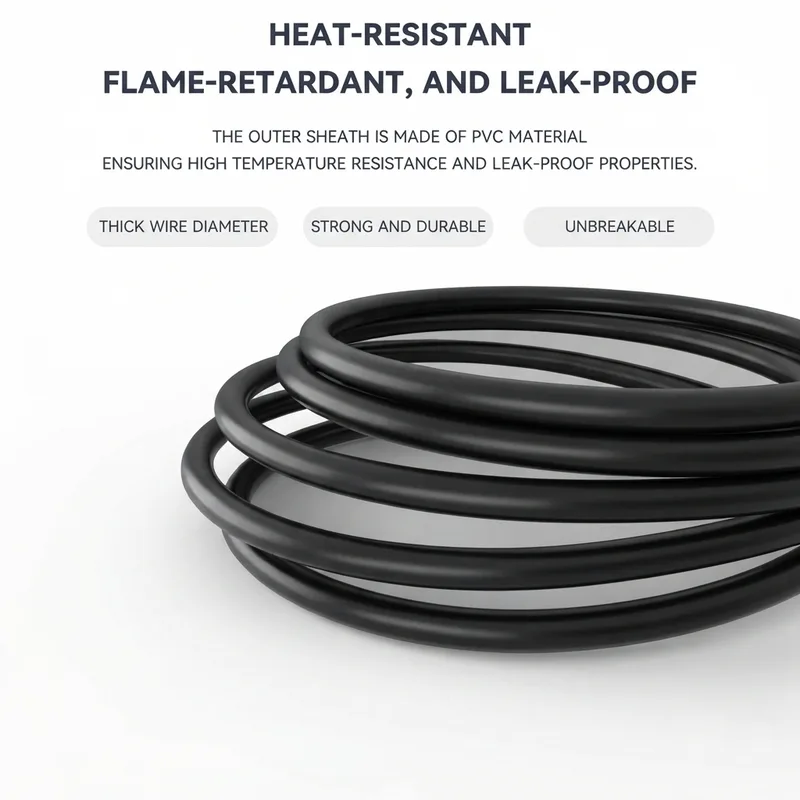
Why Does Power Cord Length Matter?
The length of a power cord affects how easily equipment can be connected to a power source and how efficiently the cable can be managed.
A cable that is too short may require additional extension cords or make installation inconvenient. On the other hand, an unnecessarily long cable can create excess loops, increase material usage, and make cable management more difficult.
For electrical applications, length can also interact with wire gauge and current load. As the conductor length increases, resistance increases, which can contribute to voltage drop under load.
For this reason, power cord length should be selected together with cable specification, conductor size, rated current, and application environment.
How Long Should a Power Cord Be?
There is no single “best” power cord length for every application.
The ideal length depends on the equipment, installation position, distance to the power source, cable routing, and required cable management.
Here is a practical reference:
| Application | Common Length Range | Typical Consideration |
|---|---|---|
| Desktop equipment | 1.5–2 m | Clean cable management |
| Household appliances | 1.5–3 m | Convenient outlet access |
| Office equipment | 1.5–3 m | Desk and equipment positioning |
| Power strips | 1.5–3 m | Outlet distance and workspace |
| Industrial equipment | 2–5 m+ | Equipment layout |
| Extension cords | 3–30 m+ | Load, gauge and environment |
| OEM products | Custom | Based on equipment design |
These ranges are provided for general planning only and should not be treated as electrical ratings or installation requirements. Actual cable length and conductor size should be determined according to the equipment, load, cable construction, and applicable requirements.
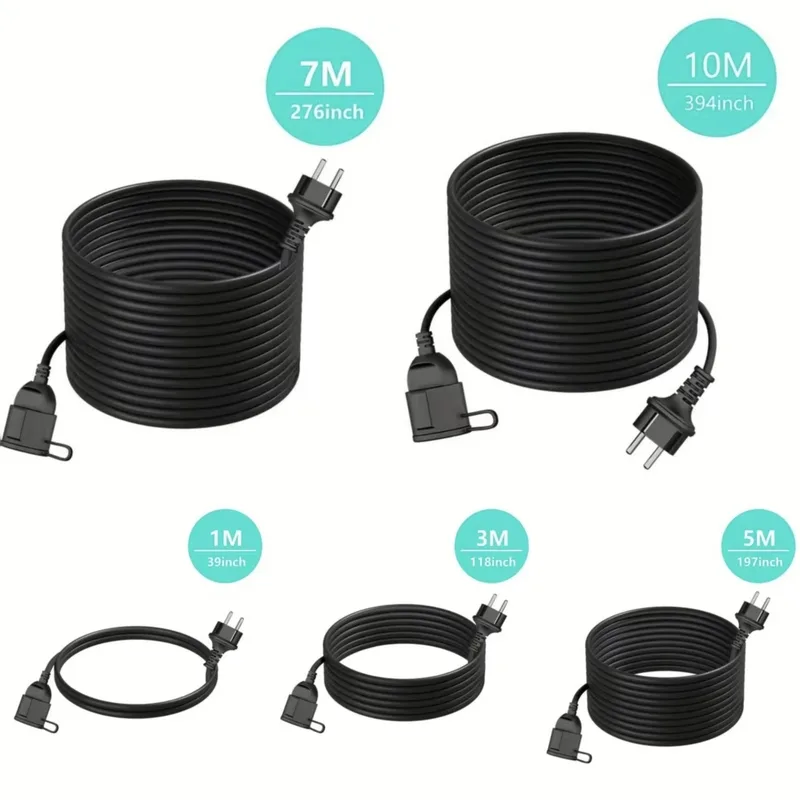
Short Power Cords: When Less Is More
Shorter power cords are often preferred when the equipment is positioned close to the outlet.
For example, computers, monitors, printers, networking equipment, and other desktop products commonly use relatively short power cords to reduce excess cable around the workspace.
A shorter cable can also make cable routing easier and help keep installations organized.
For equipment manufacturers, selecting the appropriate standard length can reduce unnecessary material while maintaining convenient installation.
Longer Power Cords: When Extra Reach Is Needed
Longer cables are useful when the equipment is positioned farther away from the power source.
Typical applications may include:
- Workshop equipment
- Garden equipment
- Construction equipment
- Large appliances
- Industrial machinery
- Outdoor electrical equipment
- Temporary power distribution
However, increasing cable length does not mean that the conductor specification can be ignored.
For longer cable runs, current, conductor size, cable construction, and voltage drop should be evaluated together. A longer cable with an undersized conductor can experience greater voltage drop under load.

Power Cord Length and Conductor Size
The relationship between conductor size and cable length becomes particularly important for longer extension cable runs. As cable length increases, electrical resistance also increases, which can contribute to greater voltage drop under load.
Common conductor sizes used in power cords and extension cables include:
- 0.75 mm² — commonly used for lighter-duty power cord applications
- 1.0 mm² — suitable for a range of general electrical applications when properly rated
- 1.25 mm² — used for selected power cord and extension cable applications
- 1.5 mm² — commonly used for higher-current power cords and extension cables
- 2.0 mm² — used for applications requiring a larger conductor cross-section
However, conductor size alone does not determine whether a cable is suitable. The rated current, voltage, cable construction, insulation material, temperature rating, installation conditions, applicable standards, and intended application should all be considered.
The relationship between cable length and conductor size becomes particularly important for longer extension cables. As cable length increases, electrical resistance also increases, which can contribute to greater voltage drop under load.
For different international applications, buyers should therefore evaluate cable length, conductor cross-sectional area, rated current, and the intended application together when selecting a power cord or extension cable.
SEBLIP offers power cords and extension cables in common conductor sizes such as 0.75 mm², 1.0 mm², and 1.5 mm², with cable length, plug type, colour, and other specifications available for OEM and ODM projects.
Does a Longer Cable Cause Voltage Drop?
Yes, cable length can contribute to voltage drop.
When current flows through a conductor, the conductor has electrical resistance. As the conductor becomes longer, its total resistance increases.
The amount of voltage drop depends on several factors, including:
- Cable length
- Conductor size
- Current
- Conductor material
- Temperature
- Cable construction
This means a long cable carrying a high current generally requires more careful specification than a short cable carrying a low current.
For example, a 10 m cable and a 2 m cable using the same conductor will not have the same electrical resistance. The longer conductor has more resistance, so voltage drop can become more significant as length increases.
Simple rule:
Longer cable + higher current = greater need to evaluate conductor size and voltage drop.
This is especially important for motors, power tools, heating equipment, and other higher-load applications.
Choosing the Right Length for Extension Cords
Extension cords are different from fixed power connections because they are commonly used to provide temporary reach between a power source and equipment.
For extension cords, users should consider:
- Required distance
- Equipment current
- Cable gauge
- Indoor or outdoor environment
- Plug and connector type
- Applicable electrical requirements
A practical rule is to choose the shortest cable that safely reaches the equipment without stretching or creating an unnecessary hazard.
Longer extension cords may require a heavier conductor depending on the load. Safety guidance also emphasizes avoiding overloaded or damaged extension cords and using cords appropriate for the application.
Common Power Cord Lengths for Different Products
Different electrical products require different power cord lengths depending on their design, installation position, and distance from the power source.Different electrical products often use different cable lengths according to their design and installation requirements.
Desktop Electronics
Computers, monitors, printers, and networking equipment commonly use relatively short cords because the equipment is normally located close to a power strip or wall outlet.
Household Appliances
Kitchen appliances, fans, lighting equipment, and other household products may require additional reach depending on where the product is positioned.
Power Strips
Power strips often use cable lengths such as 1.5 m, 1.8 m, 2 m, or 3 m, depending on the intended application.
Industrial Equipment
Industrial equipment may require longer customized cables depending on machine layout, control cabinets, power sources, and installation conditions.
For these applications, the cable length should be confirmed according to the actual equipment design rather than selected only by a standard length.
Custom Power Cord Length for OEM Projects
For manufacturers, distributors, and electrical brands, standard cable lengths may not always meet the requirements of a specific product.
That’s where custom power cord length becomes important.
An OEM power cord can be customized according to:
- Cable length
- Cable color
- Wire gauge
- Cable construction
- Plug type
- Connector type
- Terminal design
- Conductor specification
- Printing and labeling
- Packaging requirements
For example, an equipment manufacturer may require a 2.5 m power cord instead of a standard 1.8 m cable because the equipment is installed farther from the power source.
Similarly, a compact appliance may require a shorter cable to improve cable management and reduce excess material.
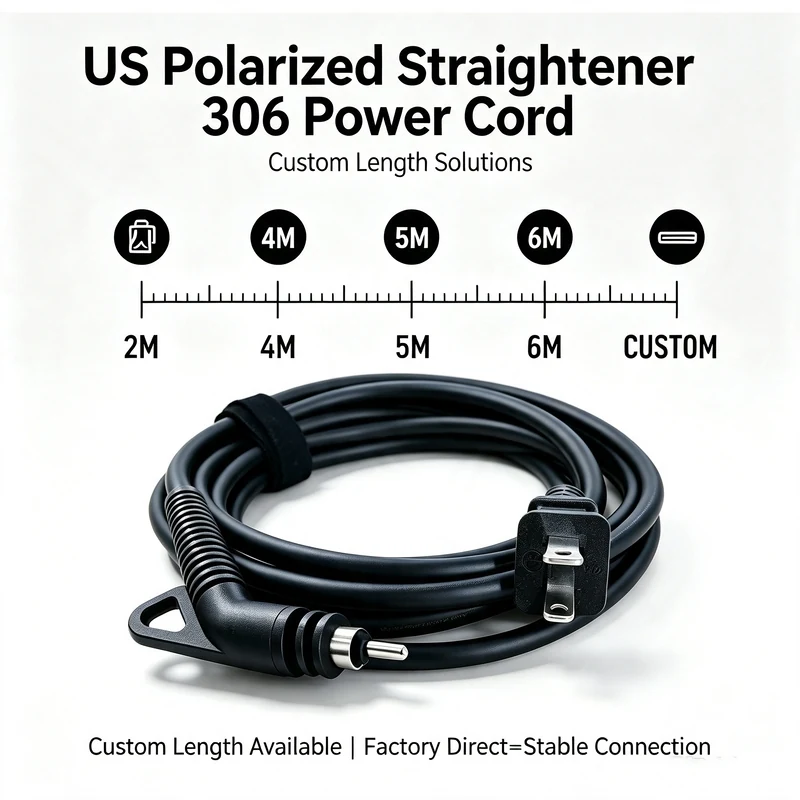
What Should Buyers Consider Before Choosing Cable Length?
Before ordering a power cord, buyers should confirm several specifications.
① Equipment Distance
Measure the actual distance between the equipment and power source.
Avoid choosing an unnecessarily long cable simply because it provides more flexibility.
② Current Rating
Check the equipment nameplate or technical documentation for the required current.
③ Wire Gauge or Conductor Size
For longer or higher-current applications, conductor size becomes increasingly important.
④ Installation Environment
Indoor, outdoor, workshop, industrial, and other environments may require different cable constructions and jacket materials.
⑤ Plug and Connector
The plug and connector should match the target market and equipment interface.
For example:
- NEMA plugs for US applications
- BS1363 plugs for UK applications
- Schuko plugs for many European applications
- IEC connectors such as C13, C14, C19, and C20 for equipment applications
Why Custom Cable Length Can Be Better for OEM Products
For OEM manufacturers, the correct cable length can improve both product usability and production efficiency.
A customized length can help:
- Reduce unnecessary cable
- Improve product appearance
- Simplify cable management
- Match equipment dimensions
- Meet customer installation requirements
- Support different market versions
Instead of supplying every product with one standard cable length, manufacturers can specify different lengths according to product design and market requirements.
This is particularly useful for OEM power cord projects, where cable length, plug configuration, conductor specification, and connector design may all need to match the final equipment.
How to Choose the Right Power Cord Length
There is no universal “best” power cord length.
The right choice depends on the distance, electrical load, conductor size, equipment design, and installation environment.
As a simple selection process:
Step 1: Measure the required cable distance.
Step 2: Check the equipment’s voltage and current requirements.
Step 3: Select the appropriate conductor size and cable construction.
Step 4: Consider potential voltage drop for longer cable runs.
Step 5: Select the appropriate plug and connector.
Step 6: Add a reasonable amount of length for installation and cable management.
For OEM projects, the final cable length can be customized according to drawings, samples, specifications, and application requirements.
FAQ
Is a longer power cord better?
Not necessarily. A longer cable provides greater reach, but excessive length can create unnecessary cable management issues and may increase voltage drop depending on the conductor size and load.
What is the most common power cord length?
Common lengths include 1.5 m, 1.8 m, 2 m, and 3 m, but the appropriate length depends on the product and application.
Does cable length affect voltage drop?
Yes. Longer conductors generally have greater resistance, so voltage drop can increase as cable length increases, especially at higher current loads.
Can power cord length be customized?
Yes. For OEM and ODM projects, cable length can typically be customized along with conductor specification, cable color, plug type, connector configuration, and other requirements.
Should I choose a thicker wire for a longer cable?
A longer cable may require a larger conductor depending on the current load and allowable voltage drop. The final selection should be based on the equipment rating and applicable electrical requirements rather than length alone.
What information should I provide when ordering custom power cords?
For an OEM quotation, it is useful to provide the required cable length, plug type, connector type, voltage, current, wire gauge or conductor specification, cable material, color, quantity, and target market.
SEBLIP — Custom Power Cord Length for OEM & ODM Projects
SEBLIP supplies power cords, extension cords, power strips, and custom cable assemblies for electrical manufacturers and OEM projects.
With 20+ years of factory experience and a 40,000 m² manufacturing facility, SEBLIP supports customized cable length, wire specifications, plug types, connector configurations, colors, printing, and packaging according to project requirements.
Whether you need a standard power cord length or a custom cable for a specific electrical product, our team can support your project from specification confirmation to production.