
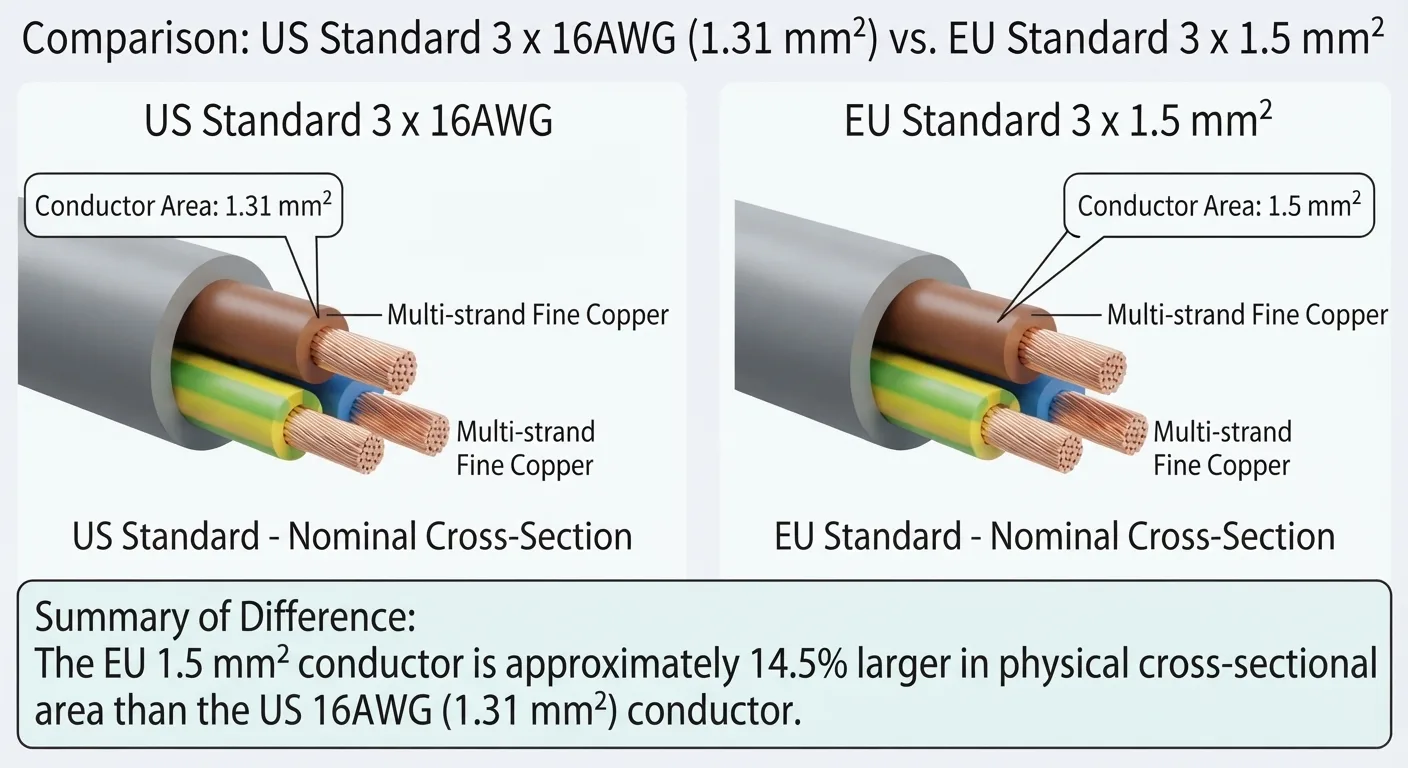
When sourcing a power cord, buyers may see cable sizes listed in AWG or mm². These two systems describe conductor size in different ways, which can sometimes create confusion when comparing power cords from different markets.
For example, a US buyer may request an 18 AWG power cord, while a European specification may require 0.75 mm² or 1.0 mm² cable.
Although AWG and mm² can be compared using approximate conversion values, they are not simply two names for exactly the same sizing system. The final power cord specification also depends on conductor material, cable construction, electrical rating, length, temperature rating, and applicable standards.
This guide explains the difference between AWG and mm², common cable-size conversions, and what B2B buyers should consider when sourcing power cords.
What Is AWG?
AWG stands for American Wire Gauge. It is a numerical system used to describe the diameter and size of electrical wire.
One important characteristic of AWG is that the number works in the opposite direction from what many people initially expect:
A smaller AWG number means a larger conductor.
For example:
- 20 AWG is smaller than 18 AWG
- 18 AWG is smaller than 16 AWG
- 16 AWG is smaller than 14 AWG
- 14 AWG is smaller than 12 AWG
AWG is commonly encountered in electrical products designed for the US market and other applications that use AWG specifications.
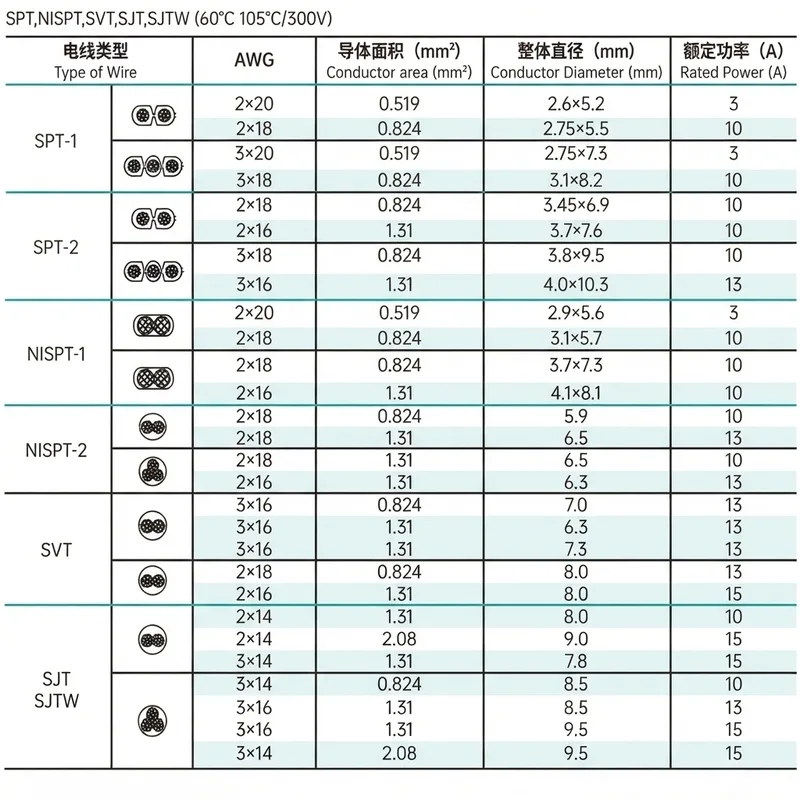
Historical wire tables published by the U.S. National Institute of Standards and Technology (NIST) also document American wire gauge and metric wire-size measurements, showing that different wire-sizing systems have long been used in different markets.
What Is mm²?
mm², or square millimeters, describes the cross-sectional area of a conductor.
Unlike AWG, where a smaller number means a larger conductor, the relationship with mm² is straightforward:
A larger mm² value means a larger conductor cross-sectional area.
For example:
- 0.75 mm² is smaller than 1.0 mm²
- 1.0 mm² is smaller than 1.5 mm²
- 1.5 mm² is smaller than 2.5 mm²
Metric conductor sizing is widely encountered in European and many international cable specifications.
For B2B buyers sourcing power cords internationally, understanding both systems can make communication with suppliers easier.

AWG vs mm²: What Is the Difference?
The main difference is how conductor size is expressed.
AWG uses a standardized gauge number, while mm² directly expresses the conductor’s cross-sectional area.
Here are several commonly encountered approximate comparisons:
Common AWG to mm² Conversion
| AWG | Approx. Cross-Sectional Area |
|---|---|
| 20 AWG | 0.52 mm² |
| 18 AWG | 0.82 mm² |
| 16 AWG | 1.31 mm² |
| 14 AWG | 2.08 mm² |
Important: These are approximate cross-sectional-area equivalents. They should be used as a reference rather than as automatic substitutions for a finished power cord.
For example, 16 AWG is approximately 1.31 mm², but that does not automatically mean that every 16 AWG power cord can simply be replaced with a 1.5 mm² power cord.
The complete cable construction and applicable requirements still need to be confirmed.
Why Can’t AWG and mm² Simply Be Interchanged?
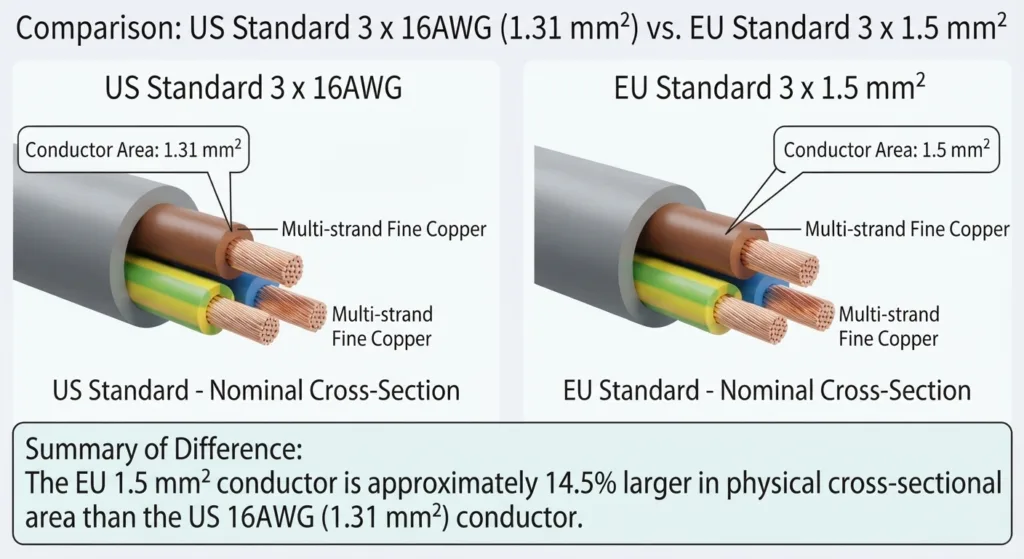
A conductor’s cross-sectional area is only one part of a finished power cord specification.
Two cables with similar conductor areas may still differ in:
- Conductor material
- Number of conductors
- Stranding construction
- Insulation material
- Jacket material
- Temperature rating
- Voltage rating
- Current rating
- Cable diameter
- Flexibility
- Applicable standard
- Plug or connector configuration
For example, an OEM buyer may specify:
3 × 1.5 mm² pure copper PVC cable
This describes more than the conductor size. It also communicates the number of conductors, conductor area, conductor material, and cable material.
Therefore, when changing an existing specification from AWG to mm², buyers should confirm the complete cable specification, rather than selecting the nearest numerical conversion.
Does a Larger Wire Size Carry More Current?
Conductor size is an important factor in determining electrical performance, but it is not correct to assign one fixed current rating to every cable based only on AWG or mm².
Allowable current depends on the complete cable construction and operating conditions.
Factors can include:
- Conductor material
- Conductor size
- Number of conductors
- Insulation type
- Temperature rating
- Ambient conditions
- Cable construction
- Installation conditions
- Applicable electrical standard
This is especially important for power cords because the finished product may need to comply with specific requirements for its target market.
For this reason, statements such as “16 AWG always supports X amps” should be treated cautiously unless the cable construction and applicable standard are clearly defined.
How Does Wire Size Affect a Power Cord?
The conductor size can influence several characteristics of a power cord.
Electrical Resistance
A larger conductor generally has lower electrical resistance for the same conductor material and length.
Lower resistance can reduce voltage drop and resistive heating under the same electrical conditions.
Voltage Drop
Cable length also matters.
As the length of a conductor increases, resistance increases. For longer power cords, the conductor size may therefore need to be considered together with the expected load and allowable voltage drop.
Common Power Cord Sizes in AWG and mm²
Different products and markets use different conductor sizes.
Some commonly encountered specifications include:
| Cable Size | Common Applications / Considerations |
|---|---|
| 20 AWG | Smaller electrical products and lighter-duty applications |
| 18 AWG | Common in many electronic and general-purpose power cords |
| 16 AWG | Larger conductor for applications requiring higher electrical capacity |
| 14 AWG | Used for higher-load applications depending on the cable construction |
| 12 AWG | Used where larger conductor capacity is required |
| 0.75 mm² | Common metric cable size for various power cords |
| 1.0 mm² | Common metric specification for many electrical products |
| 1.5 mm² | Widely encountered in power cords and extension cords |
| 2.5 mm² | Larger metric conductor size for applications requiring it |
This table is a general reference, not a current-rating chart. The appropriate cable size should be confirmed against the finished cable’s electrical requirements and applicable standard.
How to Choose the Right Power Cord Wire Size
For B2B buyers, selecting a cable size should start with the equipment requirements rather than the cable itself.
1. Confirm the Rated Current
First identify the equipment’s expected operating current.
The power cord should be appropriately specified for the intended load.
Instead of asking a supplier for a “thick cable,” provide the required current and other technical information.
For example:
Rated current: 10A
Rated voltage: 250V
Cable: 3 × 1.5 mm²
Conductor: Pure copper
Length: 2 m
This provides a much clearer starting point for a quotation.
2. Confirm the Rated Voltage
The power cord also needs to match the required voltage and cable insulation rating.
The target market should be specified because power cord requirements can differ between the US, Europe, UK, Australia, and other markets.
3. Consider Cable Length
Cable length affects resistance and voltage drop.
A short cable and a long cable carrying the same current may require different engineering considerations.
When ordering a custom power cord, buyers should therefore provide the required cable length together with the conductor specification.
4. Confirm the Conductor Material
Copper is widely used in power cords because of its electrical conductivity and flexibility.
When requesting a quotation, buyers should specify whether the cable requires:
- Pure copper
- Another conductor material
- A specific conductor construction
This avoids confusion when comparing quotations from different suppliers.
5. Check the Applicable Standard
The cable size should also be considered together with the applicable market and product standard.
Depending on the finished product and target market, buyers may encounter requirements associated with standards or certification systems such as:
- IEC
- VDE
- BS
- SAA
- ETL
- Other applicable national or regional requirements
The relevant requirements should be confirmed for the specific finished power cord, rather than assuming that one cable specification is suitable for every market.
AWG vs mm²: A Practical Example
Imagine a buyer is sourcing a power cord for a piece of electrical equipment.
The original US specification may be:
18 AWG, 3-conductor power cord
The buyer later wants to source a similar product for a market where metric cable specifications are commonly used.
18 AWG is approximately 0.82 mm² in cross-sectional area.
However, the buyer should not simply tell the manufacturer:
“Replace 18 AWG with 0.82 mm².”
The manufacturer should confirm the complete cable construction, including conductor configuration, insulation, temperature rating, electrical rating, and applicable standard.
This is particularly important for OEM and ODM projects where the power cord is part of a finished electrical product.
What Does 3 × 1.5 mm² Mean?
A specification such as 3 × 1.5 mm² generally indicates three conductors, with each conductor having a nominal cross-sectional area of 1.5 mm².
For a typical grounded power cord, the three conductors may be used for:
- Live
- Neutral
- Protective earth
Other examples include:
- 2 × 0.75 mm² — two conductors, 0.75 mm² each
- 3 × 0.75 mm² — three conductors, 0.75 mm² each
- 3 × 1.0 mm² — three conductors, 1.0 mm² each
- 3 × 1.5 mm² — three conductors, 1.5 mm² each
The exact conductor arrangement should be confirmed according to the applicable cable standard and product design.
WG vs mm² for US and European Power Cords
One reason buyers encounter both systems is that different markets commonly use different cable specifications.
For many US-market products, buyers may encounter AWG, such as:
- 18 AWG
- 16 AWG
- 14 AWG
- 12 AWG
For many European and international products, buyers may encounter metric sizes such as:
- 0.75 mm²
- 1.0 mm²
- 1.5 mm²
- 2.5 mm²
Neither system is inherently better.
The most important point is to follow the specification required by the equipment, destination market, and applicable standard.
What Should Buyers Include in a Power Cord RFQ?
For distributors, wholesalers, importers, and equipment manufacturers, a detailed RFQ can help reduce specification misunderstandings.
A useful power cord inquiry should include:
- Plug type
- Connector type
- AWG or mm²
- Conductor material
- Number of conductors
- Rated current
- Rated voltage
- Cable length
- Cable color
- Cable material
- Target market
- Applicable standard
- Quantity
- Packaging requirements
For example:
EU plug to IEC C13 power cord, 3 × 1.5 mm² pure copper, PVC cable, 250V, 3 m length, black.
This is much more useful for a power cord manufacturer than simply requesting a “European power cable.”
AWG vs mm² in OEM and ODM Power Cord Projects
For OEM and ODM projects, wire size is only one part of the product specification.
Depending on the product, buyers may need to customize:
- AWG or mm² conductor size
- Cable length
- Cable color
- Conductor material
- Plug type
- IEC connector
- Cable construction
- Cable marking
- Logo or labeling
- Packaging
This is why communication with the actual manufacturer can be important for custom power cord projects.
Buyers should confirm the complete specification before mass production, especially when changing between AWG and metric cable sizes.
How SEBLIP Approaches Power Cord Specifications
SEBLIP supplies power cords, extension cords, power strips, power connectors, plug components, and adapter chargers for distributors, wholesalers, importers, electrical brands, and equipment manufacturers.
With 20+ years of factory experience and a 40,000 m² manufacturing facility, SEBLIP works with different power cord specifications for international markets and supports OEM and ODM requirements.
For a custom power cord project, buyers can provide the required AWG or mm² size together with conductor material, current, voltage, cable length, plug configuration, connector, target market, and other product requirements.
The final specification should be confirmed according to the specific product and applicable requirements before production.
Conclusion
AWG and mm² are two different ways of describing conductor size.
AWG uses a numerical gauge system, where a smaller number represents a larger conductor, while mm² directly expresses the conductor’s cross-sectional area.
Approximate conversions can help buyers compare specifications, but they should not be treated as automatic replacements.
When sourcing a power cord, the correct cable size should be considered together with current, voltage, cable length, conductor material, cable construction, temperature rating, application, and applicable standards.
For B2B buyers, providing a complete technical specification is one of the simplest ways to improve communication with a power cord supplier or manufacturer and reduce specification errors before production.
Author
By SEBLIP Technical Team
Power Cord & Electrical Cable Manufacturing Team
This article is based on SEBLIP’s experience in power cord manufacturing and international B2B electrical product sourcing. Product specifications should be confirmed according to the specific application and applicable standards.