
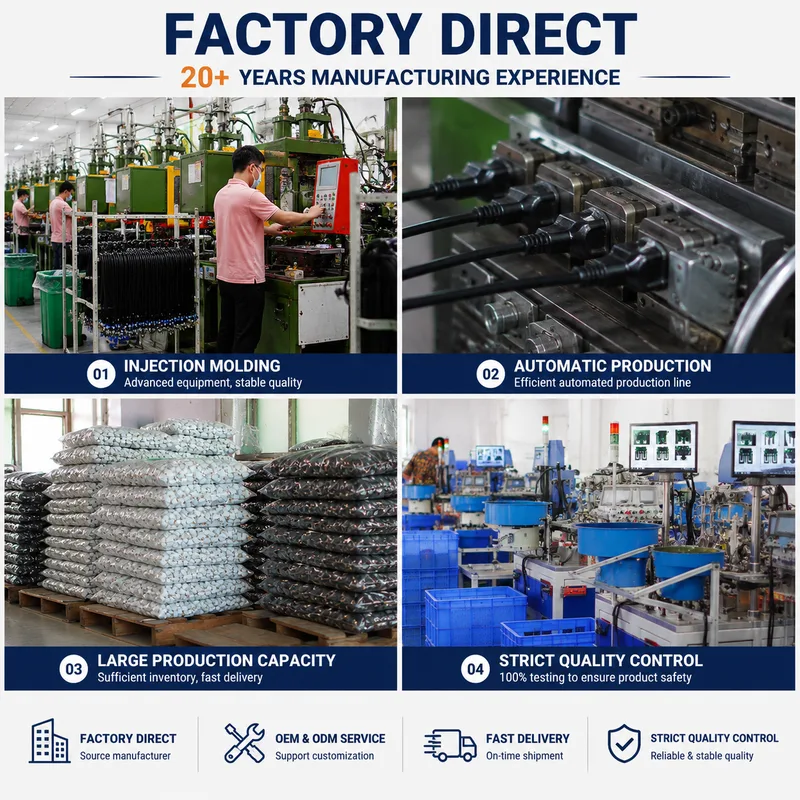
For distributors, wholesalers, importers, electrical brands, and equipment manufacturers, choosing the right power cords can affect product quality, cost control, customization, and long-term supply.
When sourcing from China, buyers may work directly with a manufacturer, an OEM factory, or an intermediary such as a trading company or sourcing agent. These suppliers can offer different advantages, but their roles and capabilities are not always the same.
Understanding the difference can help B2B buyers choose a supply model that matches their product requirements.
What Is a Source Factory?
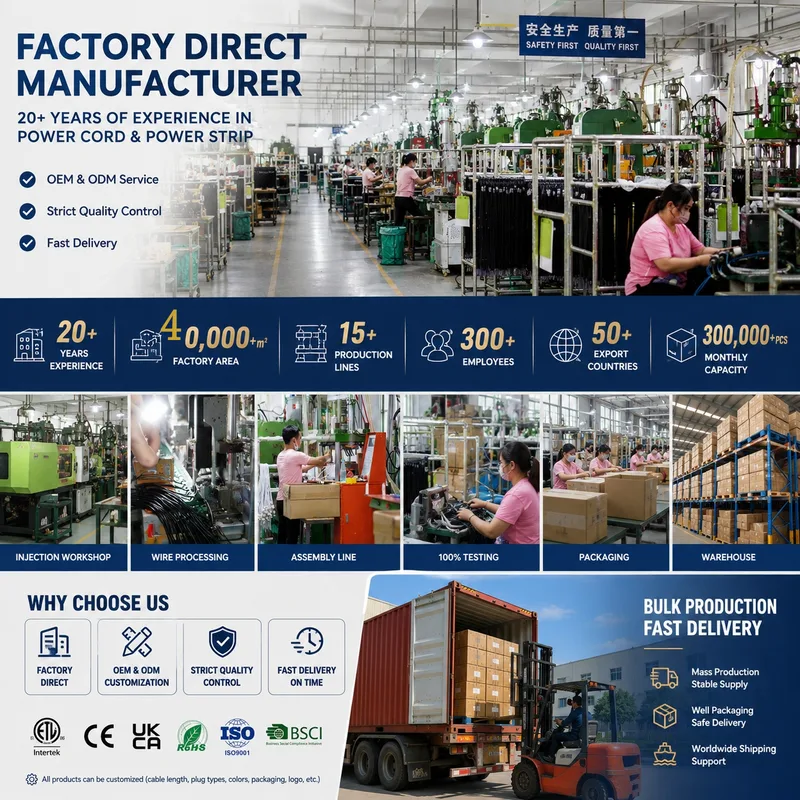
A source factory is a company that directly owns or operates manufacturing facilities and production processes for its products.
For power cords, this may include processes such as cable preparation, conductor processing, injection molding, plug assembly, terminal assembly, testing, inspection, and finished-product packaging.
A direct manufacturer can communicate with buyers about technical specifications and production requirements without relying entirely on another supplier.
For example, a buyer may need a specific:
- Plug type
- Cable length
- Wire gauge
- Conductor material
- Connector
- Current and voltage rating
- Cable color
- Logo or marking
- Packaging configuration
Working directly with a factory can simplify communication between the buyer and the production team.
Manufacturer vs. Intermediary: What Is the Difference?
An intermediary does not necessarily operate the manufacturing process itself. It may purchase products from one or more factories and then sell them to overseas customers.
This model can still be useful, particularly when buyers need help with supplier sourcing, product selection, logistics, or multiple product categories.
However, the supply chain can become longer.
A simplified comparison looks like this:
| Factor | Direct Manufacturer | Intermediary / Trading Company |
|---|---|---|
| Production control | Direct | Usually relies on external factories |
| Technical communication | Direct with manufacturer | May pass specifications to factory |
| Customization | Usually handled directly | Depends on partner factories |
| Factory visibility | Generally higher | Depends on supplier relationship |
| Price structure | Factory-based quotation | May include intermediary margin |
| Quality control | Production-side control | May rely on external factory |
| Product range | Based on own capabilities | May cover multiple factories |
| Communication chain | Shorter | Potentially longer |
Neither model is automatically suitable for every buyer. The right choice depends on the product, order size, customization requirements, and level of technical support needed.
Why Consider Direct Factory Sourcing?
More Direct Cost Communication
When buying directly from a manufacturer, buyers can communicate with the production side about materials, specifications, quantities, and packaging.
This can make quotation structures easier to understand.
However, the lowest factory quotation does not automatically mean the lowest total purchasing cost. Buyers should also consider quality, testing, packaging, shipping, rejected products, and repeat-order consistency.
Faster Technical Communication
Power cords are specification-sensitive products.
A small change in wire gauge, plug configuration, connector, cable length, or conductor material can affect the finished product.
When buyers communicate directly with the manufacturer, technical requirements can be discussed more directly with the production and engineering teams.
This can help reduce misunderstandings during product development.
Better OEM & ODM Coordination
For customized power cords, buyers may need more than a standard catalog product.
Manufacturers may also provide related products such as extension cords, depending on their production capabilities.
For buyers sourcing complete power connection products, related power strips can also be sourced from manufacturers with broader production capabilities.
A manufacturer may be able to support:
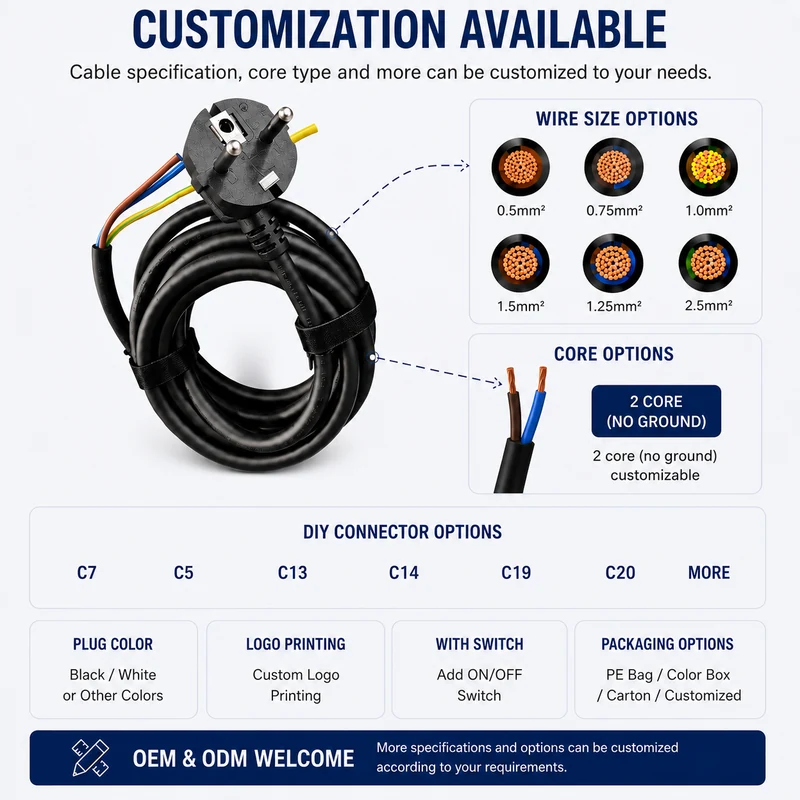
- Custom cable length
- Different plug standards
- Wire gauge selection
- Cable colors
- Connector configurations
- Cable markings
- Molded logos
- Custom components
- Labeling
- Packaging
The actual customization capability should always be confirmed for the specific factory and product.
Factory Quality Control vs. Reselling
Quality control is another important difference to consider.
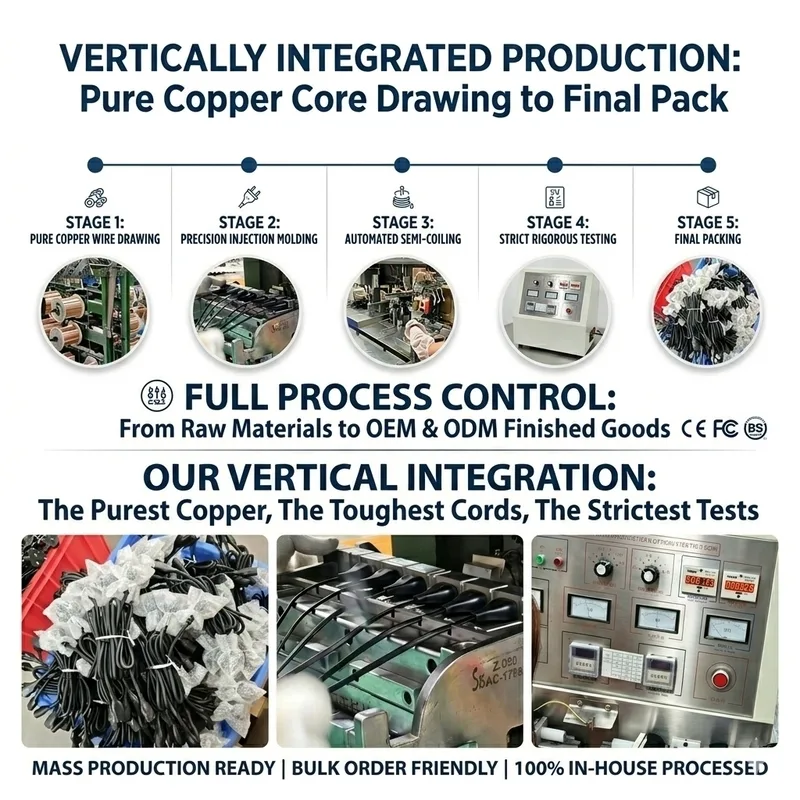
A direct manufacturer may control multiple stages of production, including incoming materials, component inspection, assembly, electrical testing, visual inspection, and finished-product inspection.
For power cords, quality checks may include:
- Conductor and cable specification
- Terminal and plug components
- Assembly quality
- Continuity testing
- High-voltage testing where applicable
- Visual inspection
- Finished-product inspection
An intermediary may also provide quality control, but the actual inspection process may depend on the manufacturing partner.
For B2B buyers, it is therefore useful to ask:
Who actually manufactures the product?
Where is quality inspection performed?
Can the supplier provide product specifications and applicable test or certification information?
These questions help buyers understand the actual supply chain rather than relying only on a supplier’s trading profile.
Direct Factory Sourcing Can Simplify Repeat Orders
For B2B buyers, the first order is only part of the purchasing process.
Repeat orders require consistency in:
- Cable construction
- Conductor specification
- Plug configuration
- Connector dimensions
- Electrical rating
- Product appearance
- Packaging
- Labels and markings
Direct communication with the manufacturer can make it easier to maintain the same product specification across repeat orders.
This is particularly important for distributors and brands that sell products under their own packaging or require stable product specifications across different batches.
When Can an Intermediary Be Useful?
Intermediaries can provide useful services in some purchasing situations.
For example, a trading company or sourcing agent may help buyers:
- Find suppliers
- Compare products
- Communicate across languages
- Combine products from different factories
- Coordinate logistics
- Manage smaller or mixed orders
For buyers sourcing many unrelated products, an intermediary may simplify supplier management.
A manufacturer with a broader product range may also supply related power connectors and plug components, allowing buyers to consolidate sourcing across multiple product categories.
The important point is to understand what role the supplier actually plays.
If the buyer requires deep technical customization, factory-level communication, or long-term production consistency, knowing the actual manufacturer behind the order becomes particularly important.
What Should Buyers Ask Before Choosing a Supplier?
Before placing an order for power cords, buyers can ask several straightforward questions:
1. Are you the manufacturer?
Ask whether the supplier owns or directly operates the production facility.
2. Where are the products manufactured?
A factory address and production information can help buyers understand the supply chain.
3. What products do you manufacture?
Check whether the supplier has experience with the required power cords, extension cords, power strips, power connectors, and adapter chargers for different markets.
4. Can you provide OEM & ODM support?
Ask about custom length, cable specifications, plug types, connectors, markings, packaging, and other requirements.
5. What quality controls are performed?
Ask about incoming material inspection, production inspection, electrical testing, and finished-product inspection.
6. What certifications apply to the product?
Certification requirements vary by product and market. Buyers should confirm the certification of the specific finished product rather than assuming that all products share the same certifications.
Why Choose SEBLIP as a Direct Power Cord Manufacturer?
SEBLIP provides power cords, extension cords, power strips, power connectors, plug components, and adapter chargers for international B2B customers.
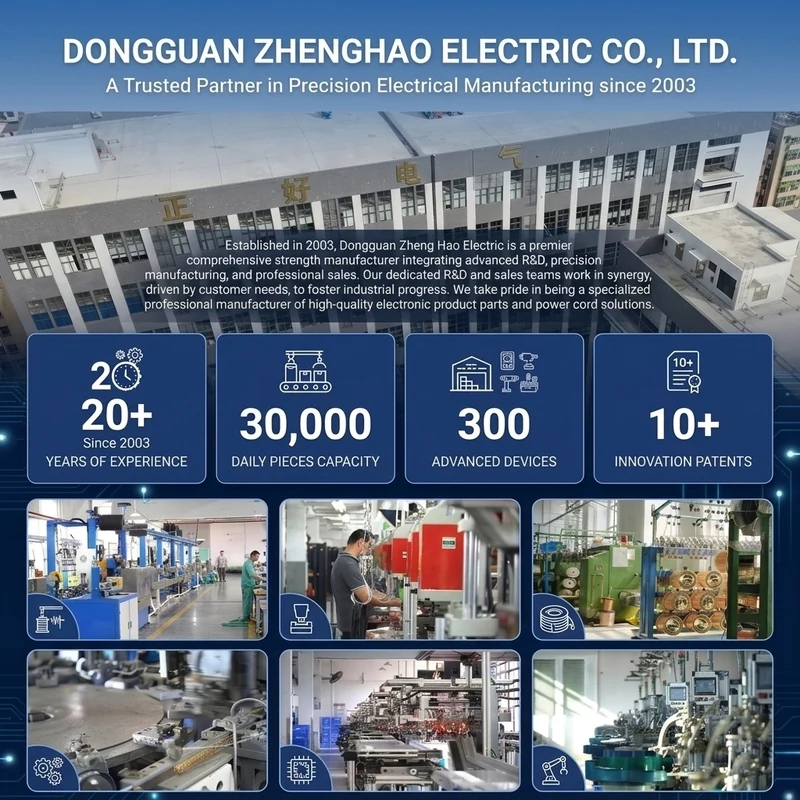
With 20+ years of factory experience and a 40,000 m² manufacturing facility, SEBLIP supports production and OEM & ODM projects for different markets and product requirements.
Customization can include:
- US, EU, UK, AU, Brazil, Italy, and other plug configurations
- Cable length and color
- Wire gauge and conductor specifications
- Connector types
- Product markings and logos
- Custom components
- Packaging requirements
SEBLIP also supports manufacturing processes including component production, injection molding, cable processing, assembly, and quality inspection.
For buyers looking for a power cord manufacturer in China, direct communication with the production team can help simplify specification confirmation, customization, quality requirements, and repeat-order management.
Conclusion
Choosing between a direct manufacturer and an intermediary depends on the buyer’s specific sourcing needs.
For standard products, an intermediary can sometimes simplify supplier management and product sourcing. For customized power cords, long-term supply, technical communication, and repeat production, working directly with a qualified manufacturer can provide a more direct connection to the production process.
Before choosing a supplier, buyers should look beyond price and evaluate manufacturing capability, product specifications, OEM & ODM support, quality control, applicable certifications, MOQ, lead time, and long-term supply consistency.
For B2B buyers sourcing power cords from China, understanding who actually manufactures the product is an important step toward building a reliable supply chain.